You can’t see the response between irrigations
Moisture by depth helps you review how the soil evolves after each application.
Check moisture and conductivity trends frequently.
AgrolabX supports monitoring of soil-grown tomatoes, outdoors or under cover. It brings together readings, recommendations and records to review the next irrigation with the right environmental context for the crop.
€15 per connected sensor per month*
No minimum fee. Hardware quoted separately.
Proposal within 24 hours · *Taxes apply
Developed in Andalusia, Spain, for the field.
Moisture by depth helps you review how the soil evolves after each application.
Changes are interpreted together with moisture, water and management, not as a direct nutrient reading.
Under cover, the conditions where the tomato grows call for appropriate environmental measurements.
Follow moisture and conductivity in the observed profile to compare irrigation and fertigation management.
WhatsApp alerts help you keep on top of monitoring; review recommendations according to soil and crop context.
For protected crops, consider indoor environmental sensors. Outdoors, a station adds local context alongside the forecast.
Platform example on an olive farm: the screenshots show that farm, not an installation in this crop. The figures illustrate the interface.
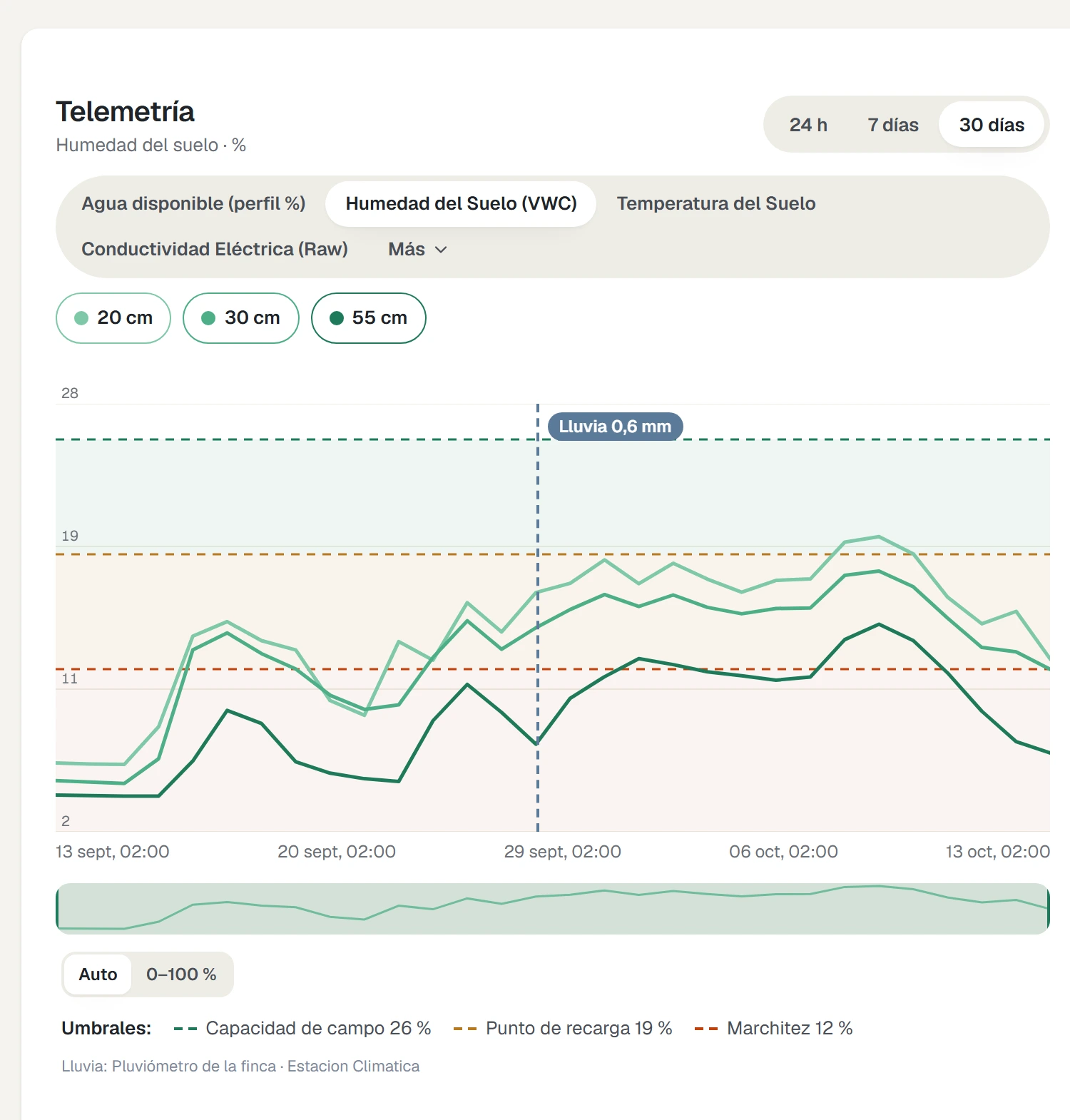
Scroll the screenshot to see the detail or open it in full.
Compare trends before and after irrigation. The thresholds and depths shown belong to this olive example, not a recipe for your farm.
Enlarge screenshot ↗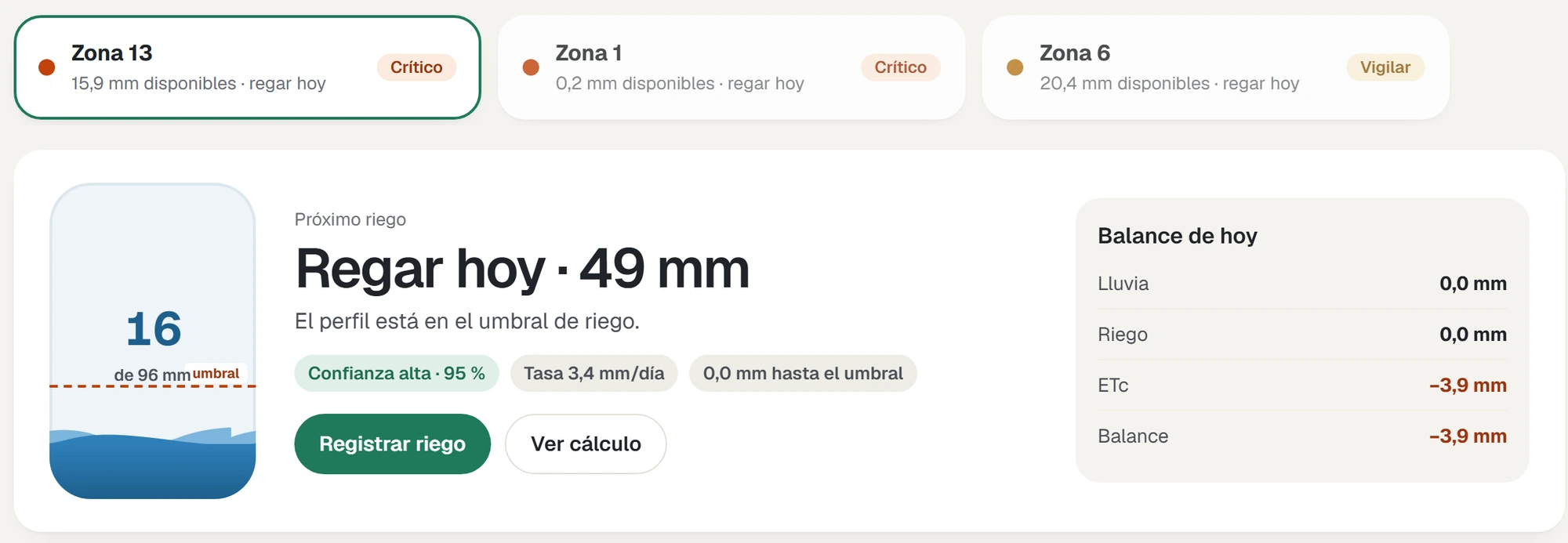
Scroll the screenshot to see the detail or open it in full.
Check the recommendation per plot, how it was calculated and the day’s balance. Review it with your agronomist before deciding how much water to apply.
Enlarge screenshot ↗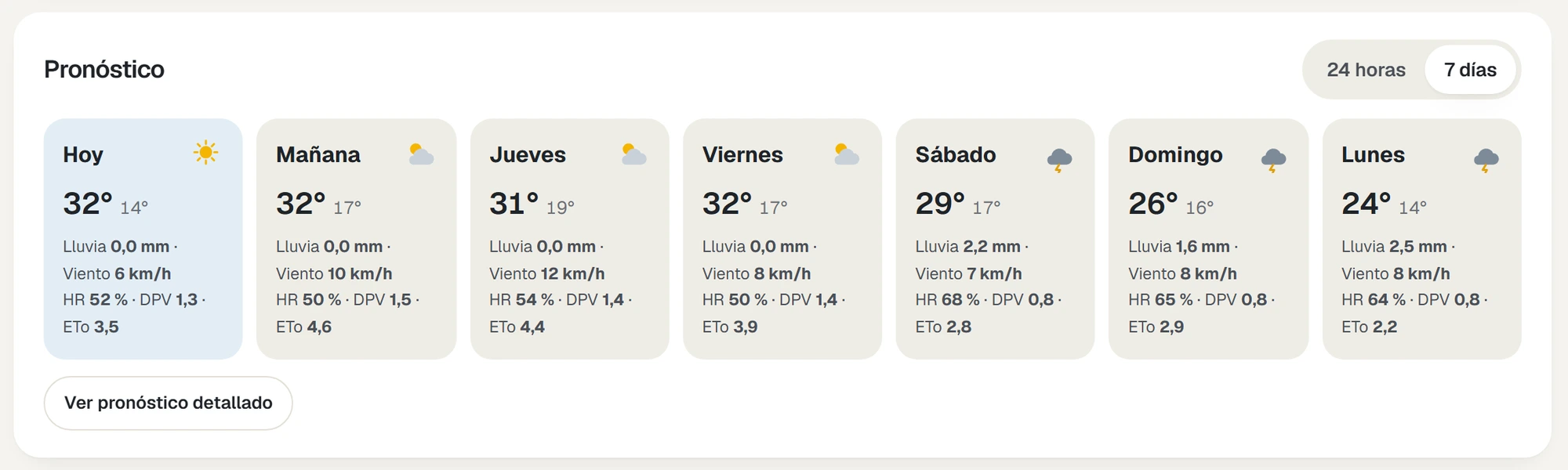
Scroll the screenshot to see the detail or open it in full.
Review forecast rain, temperature and atmospheric demand. This information is a forecast, not what a physical station has recorded.
Enlarge screenshot ↗The initial proposal focuses on soil-grown tomato. We select moisture and conductivity sensors and connectivity according to blocks and coverage.
Outdoors, consider a station. Under cover, plan appropriate indoor measurements: an outdoor station does not automatically represent conditions inside the greenhouse.
We choose the setup based on soil, irrigation blocks, coverage and needs. There is no number or depth of sensors that works for every farm.
01Tell us about your farm and what you need to monitor.
02Get a proposal within 24 hours, with platform and hardware itemised.
03We set up the solution for your needs and support you as you use it.
This page focuses on soil-grown crops. It doesn’t assume compatibility with hydroponics or substrate-specific features; those needs require checking the case and the equipment available.
The forecast describes outdoor conditions. To know the indoor conditions you need appropriate measurements inside the growing space; an outdoor station does not automatically represent it.
No. It is a variable interpreted together with moisture, water, soil and management. On its own it doesn’t give an exact fertiliser dose.
It is not presented as a reliable view of vegetation under cover. For protected crops, sensors, indoor environment and history take priority; outdoors, its usefulness is assessed for each plot.
The platform costs €15 per month per connected sensor, with no minimum fee (taxes apply). The weather station counts as a single sensor. Hardware is quoted separately. AgrolabX supports you and helps you get the most out of the solution.
AgrolabX provides information and recommendations. You and your agronomist review the decision for your farm; the platform does not open or close valves. There are no universal amounts, depths or thresholds.
The forecast anticipates weather conditions; the station records local measurements depending on its equipment. ETo is an atmospheric reference and estimated ETc applies the crop context. None of them is a direct measurement of your plants’ water use.
Tell us your region, area and what you need to monitor. You’ll receive a proposal for tomato within 24 hours.
€15 per connected sensor per month*, no minimum fee. Hardware separate. *Taxes apply.