
Which sensors does a greenhouse need?
Start with the decision you want to improve. To review irrigation, measure the water status in the soil or substrate. To understand the indoor environment, monitor temperature and relative humidity. Add radiation, electrical conductivity or leaf wetness only when they add context to your management.
Before buying, define:
- crop and production system;
- soil or substrate;
- blocks and known differences;
- decisions you want to review;
- connectivity and how often you’ll check;
- who will interpret the data.
Four questions before choosing greenhouse sensors
The word “greenhouse” doesn’t describe a single kind of installation. Soil-grown tomatoes, strawberries in substrate and a seedling nursery have different root volumes, irrigation, blocks and risks. The amount of equipment isn’t decided by hectares alone.
When and how much to irrigate?
Moisture or water potential in the root zone help you see how the medium responds after each irrigation. The reading must be interpreted according to texture, substrate, root depth, emitters and crop stage.
What environment surrounds the crop?
Indoor temperature and relative humidity help you review heat episodes, condensation and atmospheric demand. Radiation adds context about the energy the crop receives.
How is salinity evolving?
When the compatible device measures electrical conductivity, its trend can flag changes worth reviewing together with moisture, temperature, irrigation and fertigation. On its own it doesn’t identify which salts are present or prescribe a correction.
Are there conditions that deserve attention?
Leaf wetness, combined with the environment and observation of the crop, can provide information to watch for risk conditions. It doesn’t diagnose a disease or replace the agronomist.
The University of Almería (in Spanish) includes indoor temperature and relative humidity, outdoor radiation, soil and irrigation setup among the data that give context to irrigation and fertilisation decisions in protected vegetable crops.
Types of sensors and the decision they support
Usefulness depends on the sensor, its installation, calibration and interpretation protocol. No single reading determines a universal action.
IFAPA has a technical guide on using climate sensors in greenhouse crops (in Spanish), covering temperature, humidity, radiation and CO₂ among other variables. That doesn’t mean every farm needs all of them: the selection depends on what you can interpret and use.
Where to place sensors without mistaking one zone for the whole greenhouse
A sensor represents the point and depth where it’s installed. If you place it next to a leak, at an edge, under an air inlet or by an atypical plant, the data may be correct for that spot and unrepresentative for the general decision.
Divide by management
Separate blocks with different irrigation, soil or substrate, variety, age or exposure.
Choose representative points
Look for plants and emitters that describe each zone; document exceptions instead of turning them into the reference.
Define depths
Relate each measuring level to the root volume you want to observe and to the irrigation system.
Protect and document
Record location, depth, date, sensor and installation changes so you can compare seasons.
Validate in the field
Compare the charts with emitters, drainage, roots, crop and technical observation before changing management.
There is no universal number of sensors per hectare. A single point can be enough to learn in a homogeneous zone, but it doesn’t prove that every block behaves the same. Expansion should respond to differences that are worth comparing.
How much do greenhouse sensors cost with AgrolabX?
The quote separates two items: one-off hardware and platform per connected sensor. The platform costs €15 per connected sensor per month, with no minimum or base fee. Taxes apply and the hardware is bought separately.
Each soil sensor counts as one unit, whether it measures one, two or three depths. A weather station counts as one sensor in total, even when it includes solar radiation. Leaf wetness counts as another sensor.
One soil or substrate point
One connected sensor equals €15/month* of platform. The cost of the device is paid once and depends on the depths and model chosen.
Soil + weather station
Two connected sensors equal €30/month* of platform: one soil sensor and one station. Hardware is quoted separately.
Soil + climate + leaf wetness
Three connected sensors equal €45/month* of platform. This combination only makes sense if leaf wetness answers a real monitoring need.
*Taxes apply. The examples explain how the fee is calculated; they are not a universal installation recommendation. Check the current platform and hardware prices before deciding.
What a connected platform adds compared with isolated readings
A local display may be enough to check a one-off reading. A platform becomes more useful when you need to follow trends, compare zones, relate soil and climate or get alerts without walking to every point.
From data to day-to-day monitoring
With compatible devices, AgrolabX brings together soil and climate readings, weather data, forecasts and history per plot. You can set alerts by WhatsApp or email, check irrigation recommendations and share information with authorised users.
The platform helps detect situations that deserve a review. By default it doesn’t physically irrigate, doesn’t diagnose pathogens and doesn’t replace agronomic interpretation.
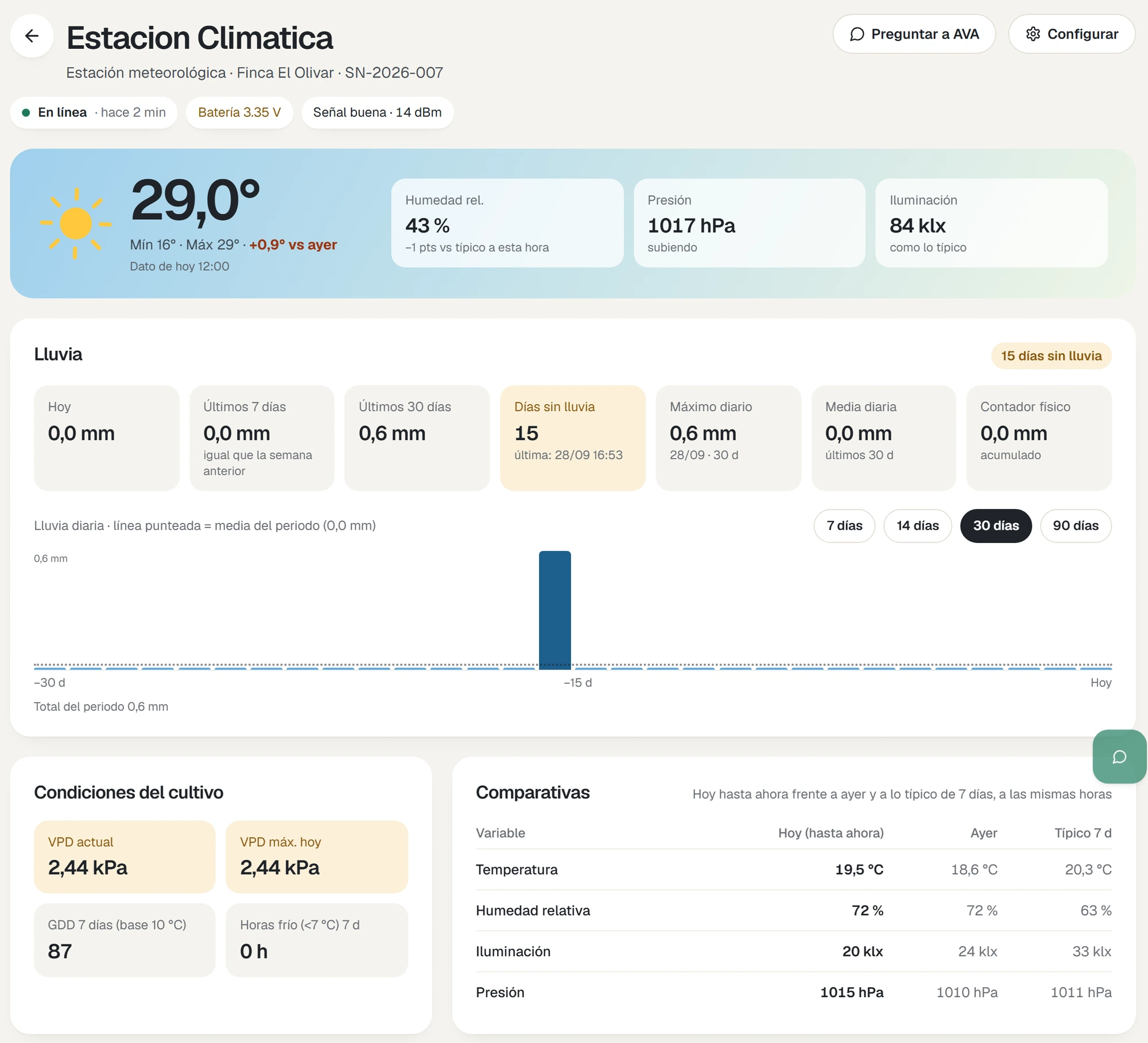
Authentic AgrolabX screenshot. The figures shown illustrate the interface and do not prove an agronomic or financial result.
Example: starting in a tomato greenhouse without oversizing
Imagine a soil-grown tomato greenhouse with two irrigation blocks and an area that usually dries out first. The goal isn’t to automate everything, but to check whether the soil’s response matches the schedule and to understand the indoor environment.
A first proposal could monitor one representative point in the main block and add climate context. If the curves show persistent differences with the second block or the problem area, an additional point is considered. The decision is made after observing, not before measuring.
In a 2025 training resource, IFAPA shows how on-demand irrigation with electro-tensiometers (in Spanish) depends on set points linked to the physical characteristics of the soil. The example reinforces a practical idea: the threshold and response must be adjusted to the medium and the crop; they aren’t copied from another farm.
This scenario is hypothetical. It does not represent a customer, a proven saving or a final recommendation. The final setup requires reviewing crop, blocks, hydraulics, coverage and goals with your agronomist.
How to prepare a proposal you can evaluate
Before asking for a quote, gather a simple plan, crops and varieties, area, irrigation blocks, soil or substrate type, fertigation system, problems observed and available coverage. Add who will check the data and how often.
In the demo, ask to see three things: how an irrigation event appears on the chart, how periods or zones are compared and how an alert is configured. That way you can assess the workflow, not just the sensor’s data sheet.
Frequently asked questions about greenhouse sensors
How many sensors do I need per hectare of greenhouse?
There is no universal figure. It depends on blocks, soil or substrate, crop, variability and decisions. Start with representative zones and expand when a difference justifies comparing it.
Is it better to measure soil moisture or climate?
They answer different questions. Soil or substrate shows the response in the root zone; climate explains part of the demand and the crop’s environment. Together they give more context when you can interpret them.
Does electrical conductivity tell me how much fertiliser to apply?
No. EC helps you observe trends related to salts, but it depends on the medium, moisture, temperature and method. It doesn’t identify specific nutrients or prescribe a dose on its own.
Does AgrolabX switch irrigation on and off automatically?
It isn’t offered as a default feature. AgrolabX brings together data, recommendations and alerts to support decisions. Any physical automation requires a specific solution and technical validation.
How much does it cost to connect a sensor?
The platform costs €15 per month for each connected sensor, with no minimum or base fee. Taxes apply and the hardware is bought separately, just once.
Can I get alerts on my phone?
Yes. AgrolabX offers configurable alerts by WhatsApp and email. An alert flags a defined condition; it doesn’t replace checking the crop and is not a diagnosis.
Sources and scope
Institutional and academic sources consulted on 6 November 2026 (in Spanish):
- IFAPA: using climate sensors in greenhouse crops, published on 29 November 2020.
- IFAPA: smart irrigation in greenhouse horticulture with electro-tensiometers, published on 4 November 2025.
- University of Almería: VegSyst-DSS for irrigation and nitrogen fertilisation in greenhouses.
- Spanish Ministry of Agriculture (MAPA): Agroclimatic Information System for Irrigation.
The sources support the technical context of the variables and their interpretation. They do not validate AgrolabX, do not prove commercial results and do not replace the agronomic design of an installation.
Choose sensors based on your decisions, not the catalogue
Tell us your crop, area, blocks and what you want to review. In a demo you can see how AgrolabX brings together soil, climate, history and alerts before assessing a proposal for your greenhouse.