
The photograph of Deadvlei is striking for its dead trees and dunes. It works as a visual starting point to talk about water, but it doesn’t let us transfer the story of that landscape to a farm or attribute a cause to a plant on your land.
In summer it’s easy to explain any change in the crop as “just the heat”. It’s worth looking at the soil too: how much water is applied, how moisture evolves and whether blocks respond differently.
Heat, soil and irrigation: a relationship that needs context
Temperature, radiation, wind and air humidity influence evaporative demand. When these conditions change, a fixed irrigation routine may no longer fit the crop’s situation.
Heat can also cause direct damage. Not every symptom is explained by a lack of water, and irrigating more doesn’t solve every problem: species, growth stage, roots, drainage and management conditions all matter.
Weather
Weather changes atmospheric demand; ETo provides a reference, not a direct measurement of water use.
Soil
Available moisture evolves according to inputs, outputs, texture and root depth.
Irrigation review
Compare the schedule, readings and crop context before adjusting the decision with your agronomist.
What leaves don’t tell you on their own
Field observation is still essential. But a drooping leaf or a change in appearance doesn’t explain the cause by itself, and the absence of visible signs doesn’t guarantee that management is right either.
Moisture can evolve differently between blocks or depths. That difference deserves a closer look: it may be related to the soil, the installation, the water applied or other factors. It is not an automatic diagnosis.
Don’t expect a universal irrigation figure. The useful data is the data you can interpret in the context of your plots, continuously.
What you can observe before changing the schedule
Compatible, well-installed sensors let you track moisture, temperature and electrical conductivity. The trend before and after irrigation helps you ask more specific questions than a single reading.
A retention model such as Van Genuchten can relate moisture to matric tension when it has parameters suited to the soil. Not all devices measure tension directly, and an estimate is not the same as knowing the exact state of each plant.
Gather the signals
- How does moisture change after irrigation?
- Do the represented blocks behave the same way?
- Have weather conditions changed?
- Are there readings or alerts worth checking in the field?
A water balance organises estimated inputs and outputs of water. Together with measurements, it can provide criteria for reviewing management, within the limits of each source.
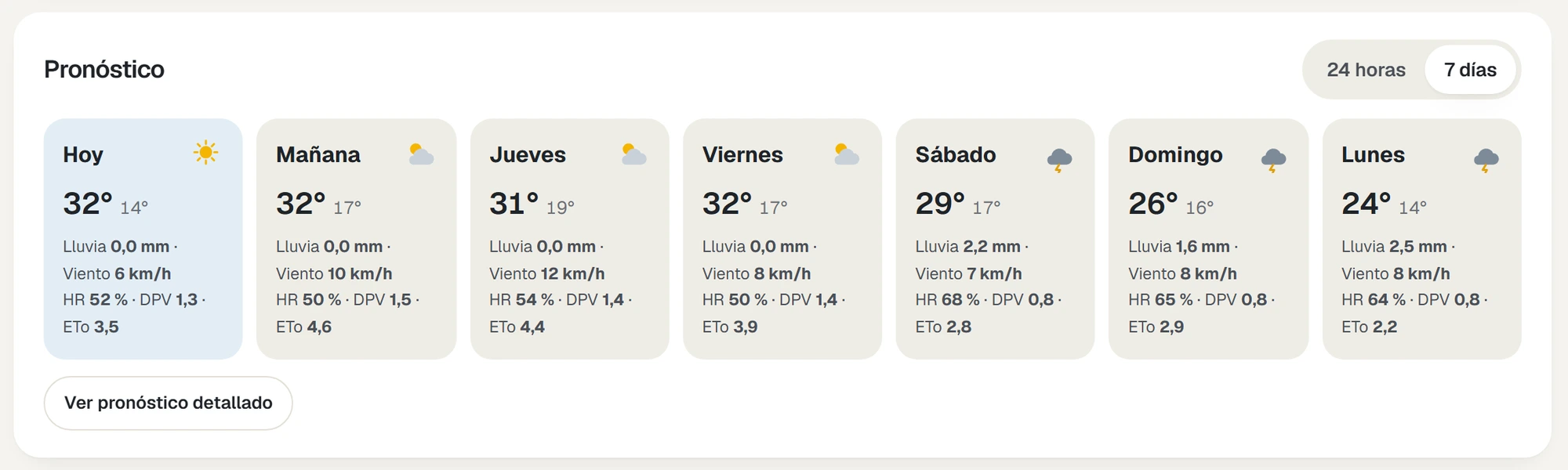
Platform screenshot. The forecast is interpreted together with field observations and soil data.
How AgrolabX helps you interpret the situation
AgrolabX brings together sensor, weather and satellite data. You can check trends, compare plots and review irrigation recommendations based on the data available.
Configurable WhatsApp alerts help you focus on situations that need reviewing. AVA lets you ask about your farm’s information, and reports make it easy to share monitoring with your agronomist.
More information to review your next irrigation, without promises of savings or guaranteed diagnoses. The platform provides recommendations; the farm manager and their advisor decide on management.
Discover irrigation recommendations · Explore the sensors · Read the glossary
A question for your next irrigation
Before repeating the calendar, check whether the water applied is producing the expected response at the soil points you observe. If something changes, compare it with the weather and a field visit before deciding.
To learn more about the relationship between weather and water, see FAO-56: crop evapotranspiration and water requirements, a general reference consulted on 13 October 2026.