Soil changes between blocks
The same schedule can produce different responses that are worth checking against local readings.
Plan season-long monitoring block by block.
For irrigated pistachio orchards, AgrolabX brings together moisture trends, recommendations and satellite data. Check the weather and share the differences you want to review with your agronomist.
€15 per connected sensor per month*
No minimum fee. Hardware quoted separately.
Proposal within 24 hours · *Taxes apply
Developed in Andalusia, Spain, for the field.
The same schedule can produce different responses that are worth checking against local readings.
Looking only at today’s value misses the rate of change and the response to the previous irrigation.
Bringing together history, weather and observations makes joint review easier when your agronomist visits.
Check the evolution by depth to review the timing and amount of water with more context.
Compare trends and recommendations per plot, interpreting each point according to its location.
Satellite data, reports and records help review changes in vigour during the season without attributing an automatic cause.
Platform example on an olive farm: the screenshots show that farm, not an installation in this crop. The figures illustrate the interface.
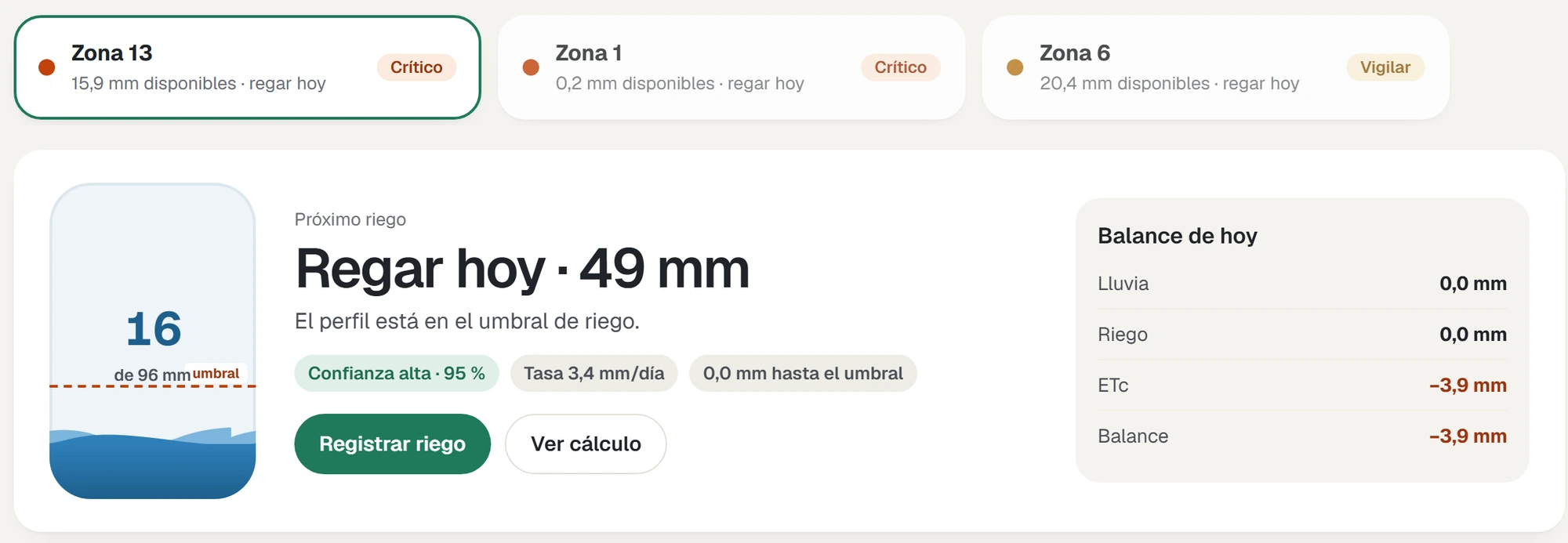
Scroll the screenshot to see the detail or open it in full.
Check the recommendation per plot, how it was calculated and the day’s balance. Review it with your agronomist before deciding how much water to apply.
Enlarge screenshot ↗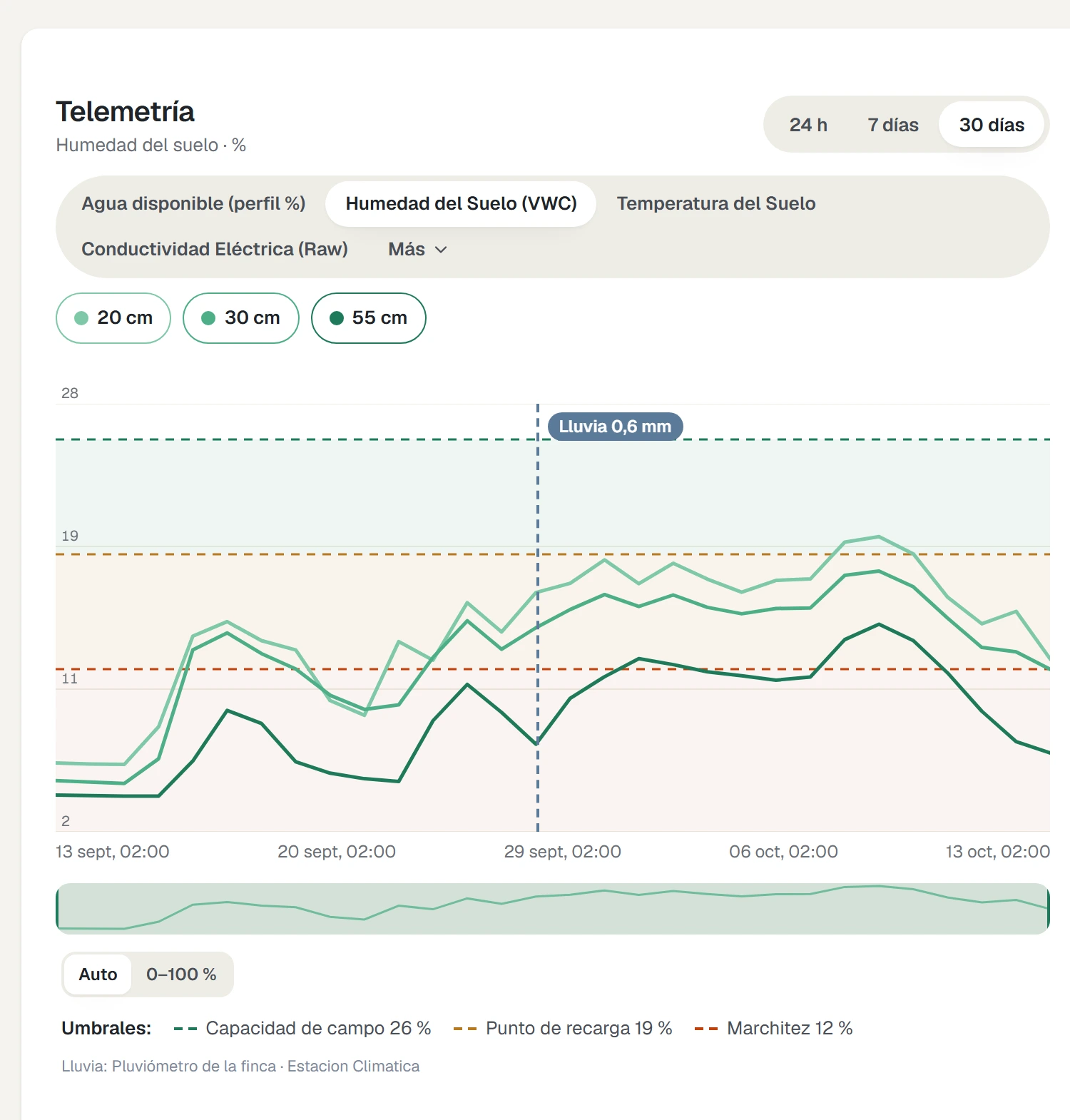
Scroll the screenshot to see the detail or open it in full.
Compare trends before and after irrigation. The thresholds and depths shown belong to this olive example, not a recipe for your farm.
Enlarge screenshot ↗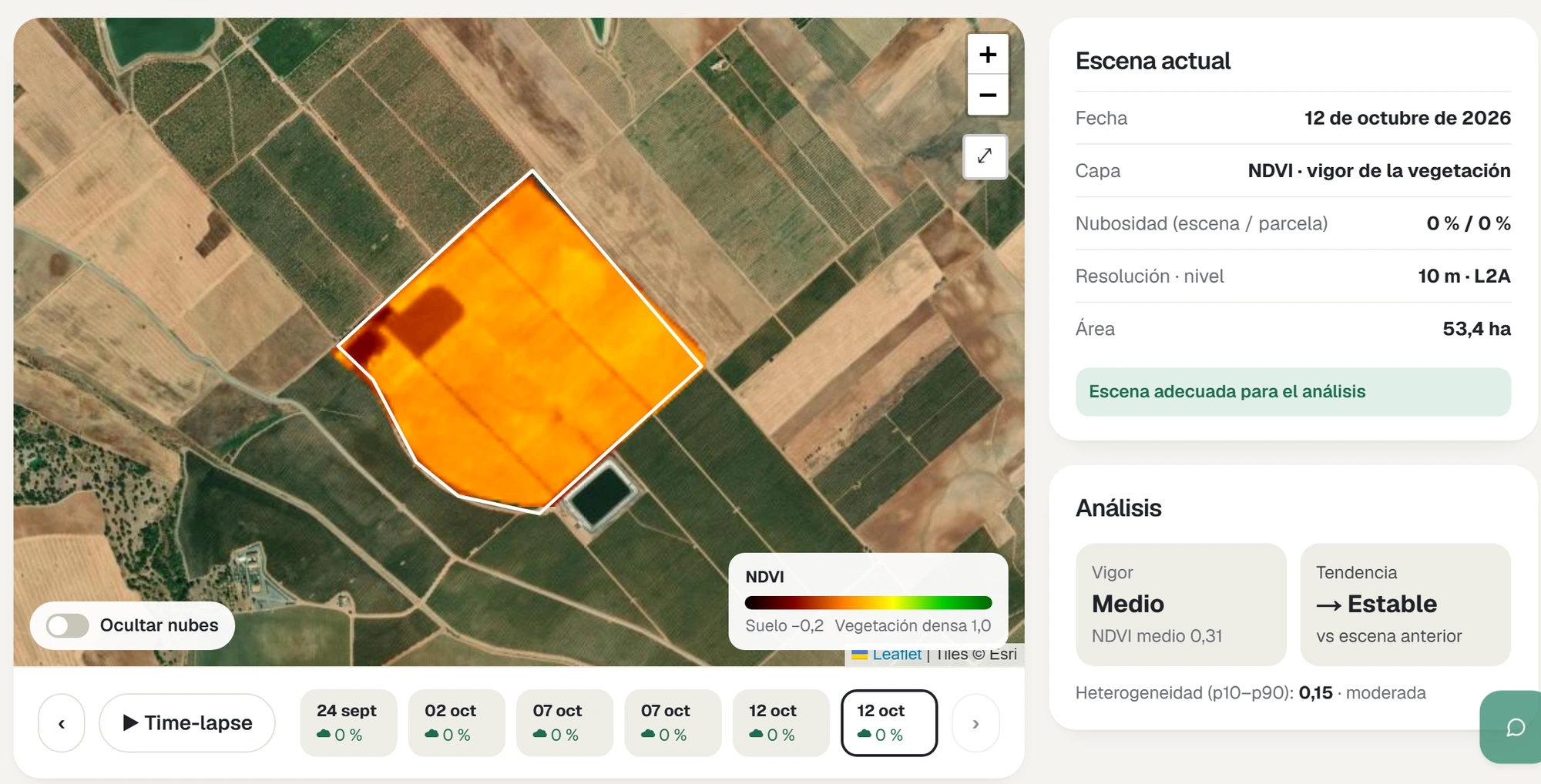
Scroll the screenshot to see the detail or open it in full.
NDVI helps locate differences and follow how they evolve. On its own it doesn’t identify the cause: interpret it together with soil, management and your agronomist’s observations.
Enlarge screenshot ↗Soil sensors distributed according to the blocks and differences you want to observe. Coverage and monitoring goals determine the equipment proposed.
The station can provide local temperature and rain to follow season conditions, kept distinct from the per-plot weather forecast.
We choose the setup based on soil, irrigation blocks, coverage and needs. There is no number or depth of sensors that works for every farm.
01Tell us about your farm and what you need to monitor.
02Get a proposal within 24 hours, with platform and hardware itemised.
03We set up the solution for your needs and support you as you use it.
To learn more about managing the crop:
IRTA: sensors and remote sensing to plan irrigation (in Spanish) ↗ITACyL: pistachio response to different irrigation levels (in Spanish) ↗No. Monitoring provides information to review water management; it doesn’t eliminate alternate bearing or guarantee a specific increase in yield.
No. The map helps locate vigour differences. Interpret it together with moisture, soil conditions, weather and observations of the plantation.
Location, area, blocks, soil differences and what you need to observe. With that information we review measuring points, coverage and configuration, without setting a one-size-fits-all kit.
The platform costs €15 per month per connected sensor, with no minimum fee (taxes apply). The weather station counts as a single sensor. Hardware is quoted separately. AgrolabX supports you and helps you get the most out of the solution.
AgrolabX provides information and recommendations. You and your agronomist review the decision for your farm; the platform does not open or close valves. There are no universal amounts, depths or thresholds.
The forecast anticipates weather conditions; the station records local measurements depending on its equipment. ETo is an atmospheric reference and estimated ETc applies the crop context. None of them is a direct measurement of your plants’ water use.
Tell us your region, area and what you need to monitor. You’ll receive a proposal for pistachio within 24 hours.
€15 per connected sensor per month*, no minimum fee. Hardware separate. *Taxes apply.