
Quick answer
Drip irrigation in vineyards should be adjusted to soil, variety, rootstock, growth stage, weather, system and production goal. There is no universal duration or frequency. Scheduling estimates a need; observing moisture at different depths helps you check what happened in the root zone after irrigating.
Before changing the schedule, review:
- what you want to achieve in that plot;
- which stage the vine is at;
- how much water the useful profile can store;
- what volume each block actually delivers;
- how moisture evolves before and after irrigation.
What drip adds and what it doesn’t solve on its own
Drip lets you place water precisely and divide the farm into blocks. It’s a practical basis for adapting turns, but it doesn’t prove that the volume applied is right or that every point receives the same.
In Spain, the Ministry of Agriculture’s 2024 irrigation analysis (in Spanish) records 361,635 hectares of localised irrigation in wine grape vineyards, far more than any other system. Being the dominant system doesn’t remove the need to schedule and check it in each plot.
Monitoring complements calculation and hydraulic review; it doesn’t replace them.
It’s worth separating three questions: the vine’s estimated need, the actual capacity of the installation and the observed response. When they get mixed up, it’s easy to blame the crop for a pressure, flow, emitter or measuring-point problem.
Data to gather before setting the schedule
The plot’s goal
The strategy changes depending on what the grapes are for and the balance sought between vegetative growth, yield and ripening. Define the goal with your agronomist before turning it into a calendar.
Growth stage
The response to deficit isn’t the same throughout the cycle. Budburst, flowering, fruit set, veraison and ripening add context to the decision, but don’t generate a recipe on their own.
Soil and roots
Texture, effective depth, stones, slope, compaction and root distribution determine how much water can be stored and where it makes sense to observe it.
Weather and rain
Temperature, radiation, humidity, wind and rainfall influence demand. The Spanish Ministry of Agriculture’s SiAR (in Spanish) provides agroclimatic data to support irrigation planning in Spain.
Installation and block
Actual flow, pressure, uniformity, number of emitters, area served and duration let you turn minutes of opening into volume applied. Without that check, hours are an incomplete unit.
Water available at the start
Winter and spring rain can recharge the profile, but its effect depends on storage capacity and how things evolve afterwards. A good start doesn’t guarantee the whole season.
In its water management trials with Tempranillo (in Spanish), ITACyL highlights precisely the influence of frequency, irrigation period, winter rain, phenology and soil profile. The operational message is clear: first you describe the plot; then you decide the strategy.
How to move from “so many hours” to a reviewable volume
Hours only become meaningful when related to the block’s actual flow rate. Before changing the duration, document the number of emitters, their checked flow, the area or number of vines served and any incidents observed.
Define the goal
Clarify which decision you want to improve: start of irrigation, frequency, duration, comparing blocks or wetting depth.
Quantify the block
Record emitters, actual flow, pressure, area, timing and volume applied; don’t settle for minutes of opening.
Estimate with weather and crop
Use agroclimatic information, the vine’s stage and technical judgement to build an initial schedule.
Observe the response
Compare the moisture trend before, during and after irrigation at relevant depths.
Check and adjust
If the response doesn’t match expectations, review installation, location, soil and crop before changing the schedule.
The result should be a traceable decision: what was expected, what was applied, what was observed and why the next irrigation stays the same or changes. That sequence is more useful than piling up readings without a specific question.
Why phenology and production goals change the strategy
Wine grape vineyards aren’t managed by always aiming to meet the theoretical maximum. CICYTEX’s practical manual on irrigating wine grapes (in Spanish) sets out different strategies depending on the production goal and the time of the cycle.
That doesn’t mean a table can simply be transferred to any farm. Variety, rootstock, crop load, climate, effective depth, stored water and management all change the response. A published strategy helps you understand variables and questions, not prescribe a universal dose from a distance.
If the grapes have a specific destination or ripening goal, agree limits and reviews with your agronomist. AgrolabX can organise data and alerts, but it doesn’t replace that agronomic decision.
How to use moisture sensors in a drip-irrigated vineyard
A compatible, well-installed probe describes one point, not the whole plot. It becomes more useful when its location represents a decision: a different block, a change in soil, an area of different vigour or behaviour worth comparing.
Look at trends, not an isolated percentage
The same percentage can mean different things in different soils. Before setting thresholds, characterise the soil and relate readings to field capacity, depth, irrigation and rain.
Several depths help you ask questions:
- if the surface layer responds and a deeper one doesn’t, review duration, location, roots and emitter;
- if they all rise quickly, check whether the volume and the point represent the strategy you want;
- if one depth stays high, check drainage, installation and the conditions at that spot;
- if there’s no response, check the sensor, connection, flow and block operation first.
These patterns are not diagnoses. They help you decide what to check in the field.
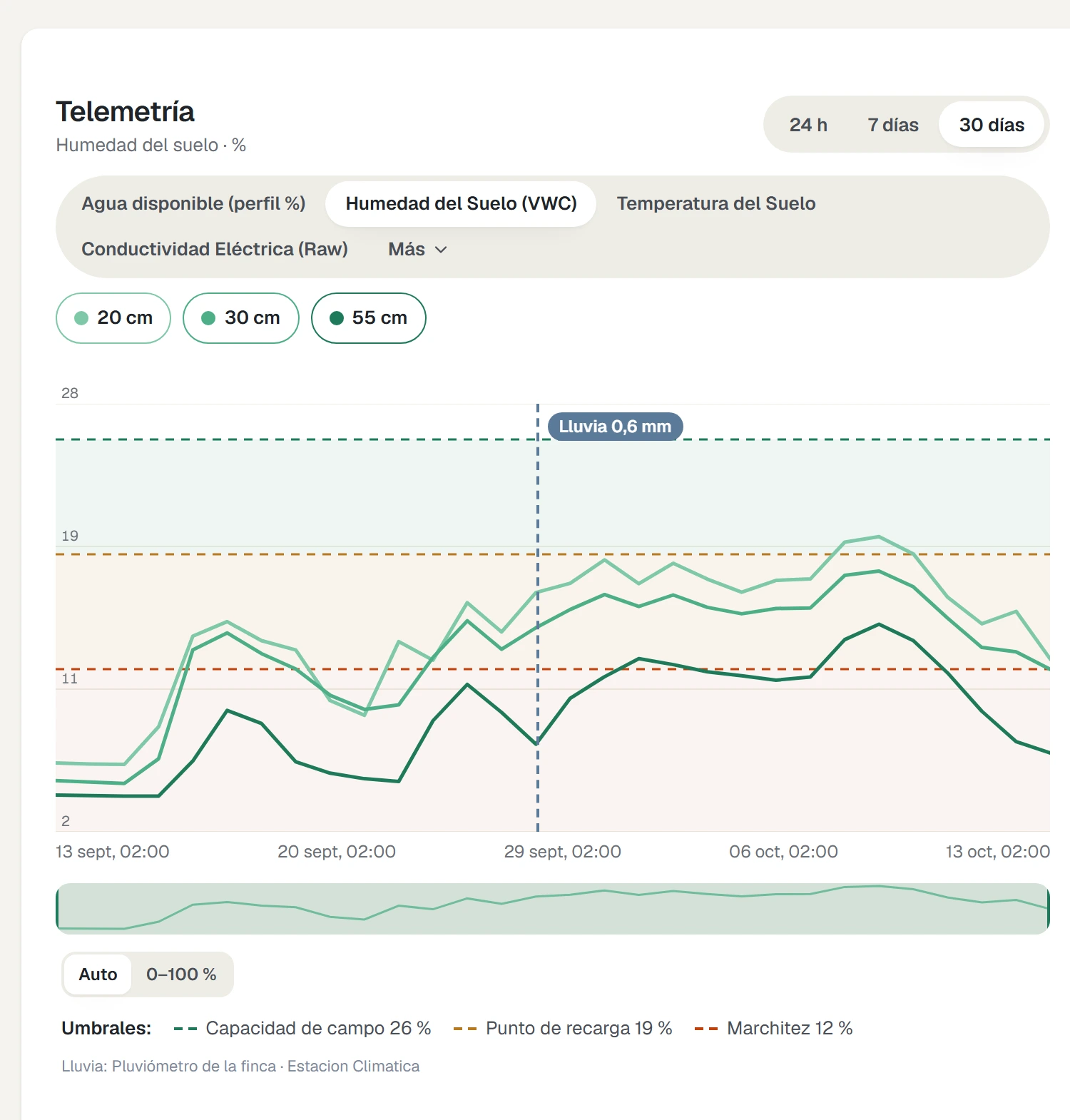
Authentic AgrolabX screenshot. The data illustrates the interface and does not represent a vineyard trial or a customer result.
How to compare blocks without jumping to conclusions
Compare equivalent situations: the same interval since irrigation, similar depths and known weather conditions. If one block was irrigated in the morning and another at night, looking at both at the same time of day can distort the comparison.
Confirm the water applied
Review the schedule, pressure, flow, filters, drippers and breakdowns. A different curve doesn’t identify the cause on its own.
Review the measured point
Distance to the emitter, a hollow or a change in texture can make a point valid for one question and unrepresentative for another.
Add weather and stage
Atmospheric demand and the time of the cycle change. Document both before comparing weeks or seasons.
Visit the plot
Use the data to target the inspection. Soil, roots, emitters and the state of the vine complete the interpretation.
A hypothetical example
Two Tempranillo blocks receive the same duration. In one, moisture rises at two depths and drops gradually; in the other, only the surface reading changes. The manager doesn’t automatically lengthen the second irrigation. First they verify flow and emitter, review the installation and sensor location, compare soil and roots and check the goal with their agronomist.
This is an illustrative example, not a real case or a verified result. The data helps prioritise a review; it doesn’t prove the cause or guarantee savings, yield or quality.
What AgrolabX brings to vineyard drip irrigation
AgrolabX brings together trends from compatible sensors, weather, the forecast and satellite monitoring so you can review the plot with more context and keep a history of decisions.
From scattered readings to a shared review
- Check moisture, temperature and EC when the installed device provides them.
- Review irrigation recommendations per plot together with the available context.
- Set WhatsApp and email alerts for situations that need attention.
- Compare plots and share history and reports with your agronomist.
- Use satellite indicators to locate differences that should then be checked in the field.
The platform helps you review when and how much to irrigate. It doesn’t open valves by default, doesn’t diagnose the vine and doesn’t guarantee a savings percentage or a specific grape quality.
Discover AgrolabX for vineyards · Explore irrigation recommendations
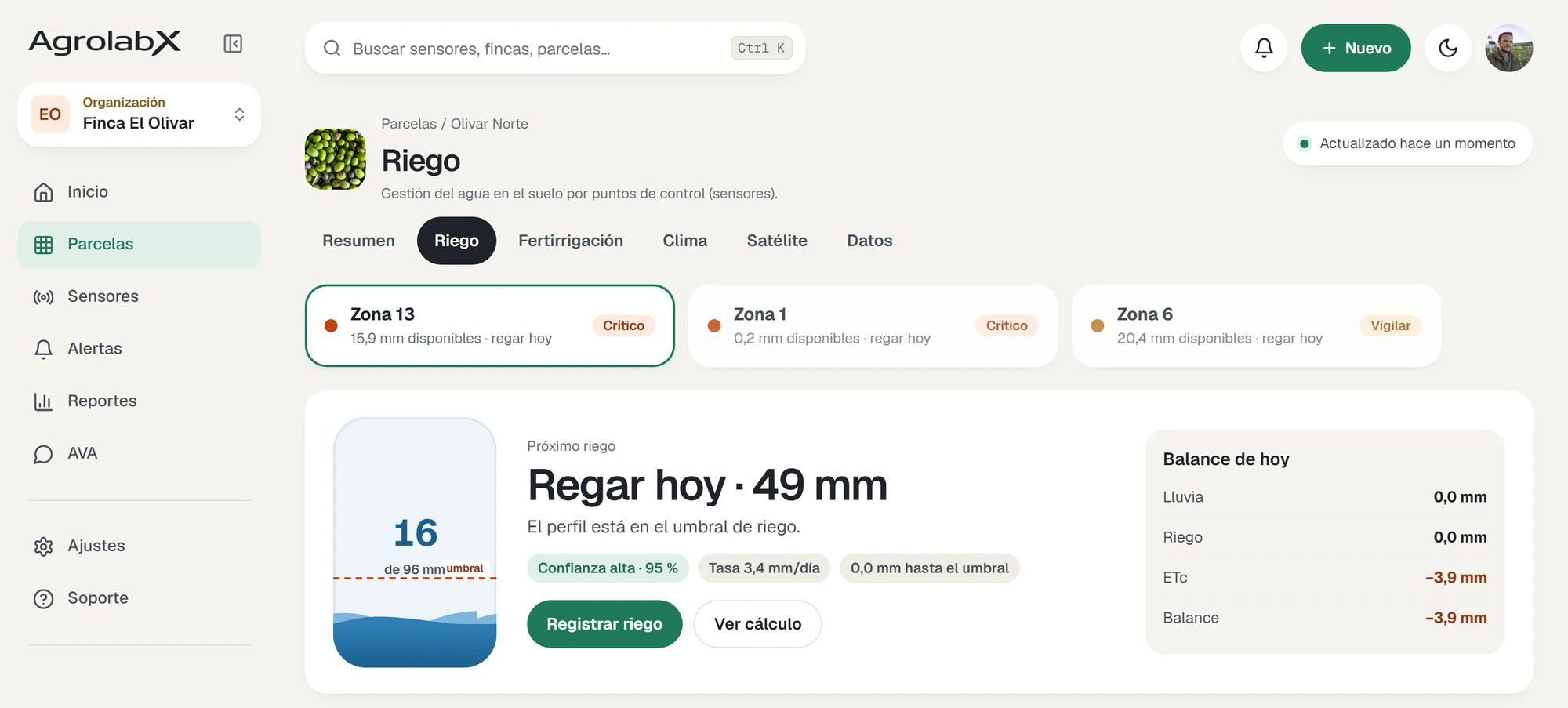
Authentic platform screenshot. The figures show the interface and do not prove an agronomic result in a vineyard.
Frequently asked questions about vineyard drip irrigation
How many hours should a drip-irrigated vineyard be irrigated?
There is no universal duration. You need to relate the target volume to the block’s actual flow rate and consider soil, weather, stage, variety, roots and production goal. Then it’s worth checking the response in the field.
When should vine irrigation start?
It depends on stored water, weather, plant condition, stage and the plot’s strategy. Earlier rain doesn’t guarantee the whole season. Decide the start with local information and technical judgement.
Where should a moisture sensor be installed in a vineyard?
At a point and depths that represent the question you want to answer, considering emitters, roots, soil, slope, blocks and variability. Document the choice and validate the installation.
Does the satellite show how much water each vine needs?
No. Satellite indicators help you see differences and how they evolve, but on their own they don’t determine an exact dose or diagnose a cause. They should be combined with soil, weather and observation.
Does AgrolabX control the valves automatically?
You shouldn’t assume so. AgrolabX brings together monitoring, recommendations and alerts to support decisions; valve automation is not a general feature to be taken for granted.
Sources and scope
Institutional sources consulted on 30 October 2026 (in Spanish):
- Spanish Ministry of Agriculture (MAPA): Analysis of Spanish irrigation 2024.
- MAPA: Agroclimatic Information System for Irrigation.
- ITACyL: water management of Tempranillo in Ribera del Duero.
- CICYTEX: practical manual on irrigating wine grapes.
These sources describe statistics, agronomic principles and public trials. They don’t validate AgrolabX, prove commercial results or justify transferring a schedule between farms.
Turn your irrigation schedule into a reviewable decision
Tell us your region, variety, hectares, blocks and what you want to check. In a demo we can show you how to relate soil moisture, weather, recommendations, alerts and history without offering a universal recipe.