Soil
Volumetric water content (VWC)
This is the proportion of a volume of soil occupied by water, usually expressed as a percentage. A probe estimates that moisture; accuracy depends on the device, calibration, soil and installation. It isn’t enough to ask whether “there is water”: what matters is how much there is and how it evolves.
Field capacity (FC) and permanent wilting point (PWP)
These are two references for describing available water. Field capacity represents the water content left after excess water has drained by gravity. The permanent wilting point corresponds to a condition in which plants can no longer regain turgor by drawing water from that soil.
Available water is estimated between the two. They are not identical thresholds for every soil: texture and root profile matter. Excess water can drain and carry nutrients with it; not all the water applied remains accessible to the roots.
Soil water tension (Van Genuchten model)
Matric tension or suction describes how the soil holds on to water. As the soil dries, it becomes harder for roots to extract it.
Van Genuchten is a retention curve model that relates water content and matric potential. Converting moisture into tension requires parameters suited to the soil: a moisture probe doesn’t directly measure the effort a root makes, nor can it diagnose the state of the plant on its own.
Electrical conductivity (EC) and relative salinity
Electrical conductivity — EC — is related to salts and to the measuring conditions. Moisture, temperature and the method used also play a part. A soil reading is not automatically equivalent to the conductivity of a laboratory extract.
A different trend deserves a closer look, together with irrigation water, fertigation and drainage. It doesn’t let you attribute a specific cause or guarantee that damage will be avoided without a technical assessment.
Weather and water
Reference evapotranspiration (ETo)
This is an estimate of the atmosphere’s evaporative demand over a reference surface. It combines evaporation and transpiration under defined conditions, using weather data such as radiation, temperature, humidity and wind.
The FAO Penman-Monteith equation is a reference method. ETo helps put irrigation in context, but it doesn’t directly measure your crop’s water use.
Crop coefficient (Kc)
It adapts reference evapotranspiration to a crop and its conditions. It varies with species, development and management. ETo × Kc estimates crop evapotranspiration (ETc) under standard conditions; on its own it doesn’t give the actual irrigation dose a plot needs.
Soil water balance
It organises water inputs and outputs: rain and irrigation against evapotranspiration, drainage and other relevant movements. It makes it possible to estimate changes in soil storage and guide irrigation reviews.
Its usefulness depends on the data and the model’s assumptions. Moisture measurements help you compare the estimated evolution with what is observed at specific points.
Total available water (TAW) and readily available water (RAW)
TAW is the estimated amount of water between field capacity and wilting point in the root zone. RAW is the fraction that can be depleted before water becomes limiting, according to the model.
The fraction depends on the crop and atmospheric demand, among other factors. There is no universal percentage or calendar. These references are interpreted together with the soil and the roots the crop actually explores.
Satellite
NDVI (Normalised Difference Vegetation Index)
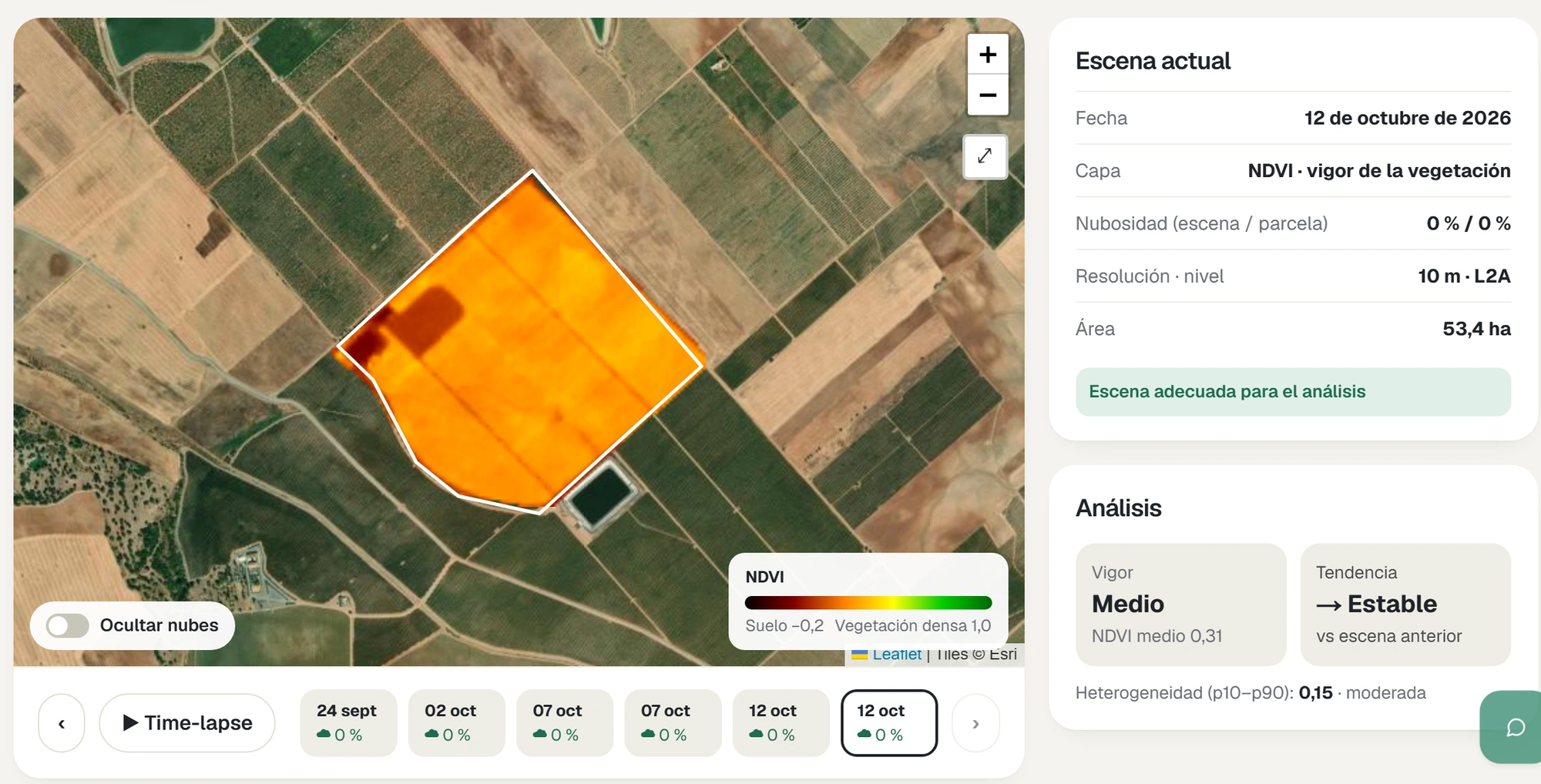
It is calculated from reflectance in red and near-infrared. It describes properties of the vegetation and lets you observe spatial differences and changes over time. Sentinel-2 is one of the sources used for this kind of monitoring.
A drop or a different-looking area does not by itself identify water, nutritional or plant-health stress. Canopy cover, soil, crop stage and image conditions all play a part. The map points to where to check; diagnosis requires more information.
SAVI (Soil-Adjusted Vegetation Index)
It introduces an adjustment to reduce the influence of the soil on the vegetation signal. It can be useful when soil is visible between plants, as in certain olive or almond planting layouts. The choice of index depends on canopy cover and the monitoring goal.
NDWI (Normalised Difference Water Index)
There are different formulations with this name. In vegetation monitoring, band combinations sensitive to canopy water content are used; other formulations target bodies of water.
It’s worth knowing which definition your tool uses. It complements observation, but it cannot reliably distinguish lack of water from pests, nutrition or other causes.
Irrigation and nutrition
Fertigation
This is the application of dissolved fertilisers through irrigation water. It lets you plan nutrient supply alongside irrigation and requires reviewing doses, compatibility, water quality, soil and crop needs.
Conductivity can add context to salinity monitoring, but it doesn’t automatically determine a fertilisation recipe.
Data-driven irrigation recommendation
It combines available soil, weather and model information to help you review when and how much to irrigate. Some systems also incorporate satellite information. It is interpreted per plot, according to crop, stage, installation and data quality.
A recommendation is decision support, not a guarantee or an automatic command to the valves. The farm manager and their agronomist weigh the proposal against the real conditions on the farm.
To keep learning
AgrolabX brings together soil, weather and satellite data so you can check trends and review decisions with more context. If you’d like to see how these indicators relate on the platform, we can show you in a demo.
Further reading: FAO-56: crop evapotranspiration and water requirements and NASA: measuring vegetation (NDVI and EVI). Consulted on 13 October 2026. These are general references, not proven AgrolabX results.