
What monitoring the truffle brûlé can tell you
In a black truffle (Tuber melanosporum) orchard, measuring soil moisture and temperature around the brûlé helps answer practical questions: did irrigation reach the layers you want to observe, how quickly is the soil drying between events, and what changes after hot weather or rain?
A connected sensor lets you follow these trends remotely. It does not detect truffles or forecast harvests; it gives growers information about underground conditions to support irrigation reviews.
After irrigation, check:
- which depth responds first;
- whether moisture changes further down;
- how long the response lasts;
- how soil temperature evolves;
- whether the emitter or the next irrigation plan needs checking.
Why soil moisture matters for black truffles
The brûlé is an area of sparse vegetation often found around holm oaks or other trees associated with Tuber melanosporum. It reflects fungal activity, but does not guarantee truffle production.
Soil water availability matters because black truffles develop underground. A University of Salamanca and CITA Aragón study of soil moisture and black truffle production compared production records from 175 Spanish locations with root-zone moisture estimated by a hydrological model. It found relevant relationships in summer and also in October and November.
This was not a trial of AgrolabX sensors and it cannot establish a yield increase from installing probes. Its practical message is that accumulated rainfall and the water actually available in soil are not the same measurement.
The surface may look wet after microsprinkler irrigation while a deeper layer barely changes. Conversely, the topsoil may dry while moisture persists below. Monitoring the profile helps distinguish these situations.
Soil temperature adds another part of the picture
Air temperature is not the temperature beneath the brûlé. Shallow soil responds more quickly to weather changes, while deeper layers may follow a different pattern.
Monitoring soil temperature helps put moisture trends in context, track warming and cooling periods, and compare conditions across the growing season. It also lets growers review how both variables respond after irrigation or rain.
A single sensor temperature threshold cannot diagnose the condition of the fungus or predict a harvest. Interpretation depends on the soil, season and field observations.
Three depths: what 10, 20 and 40 cm can show
Monitoring at 10, 20 and 40 cm may be a useful starting point for studying water movement in a particular orchard. It is not a universal prescription: depths should reflect the soil, irrigation system, root distribution and where truffles have been observed.
10 cm · Shallow layer
Shows the early response to rainfall or microsprinklers and how the soil nearest the surface dries.
20 cm · Middle layer
Tracks a depth that may be relevant where field observations place part of the fruiting activity nearby. Not all truffles develop at this depth.
40 cm · Deeper profile
Helps reveal whether an irrigation event affects deeper soil and how long moisture persists. A rise here is not automatically good or bad.
The aim is to compare the three trends, not chase a universal moisture percentage. Different responses give you a specific question to investigate on site.
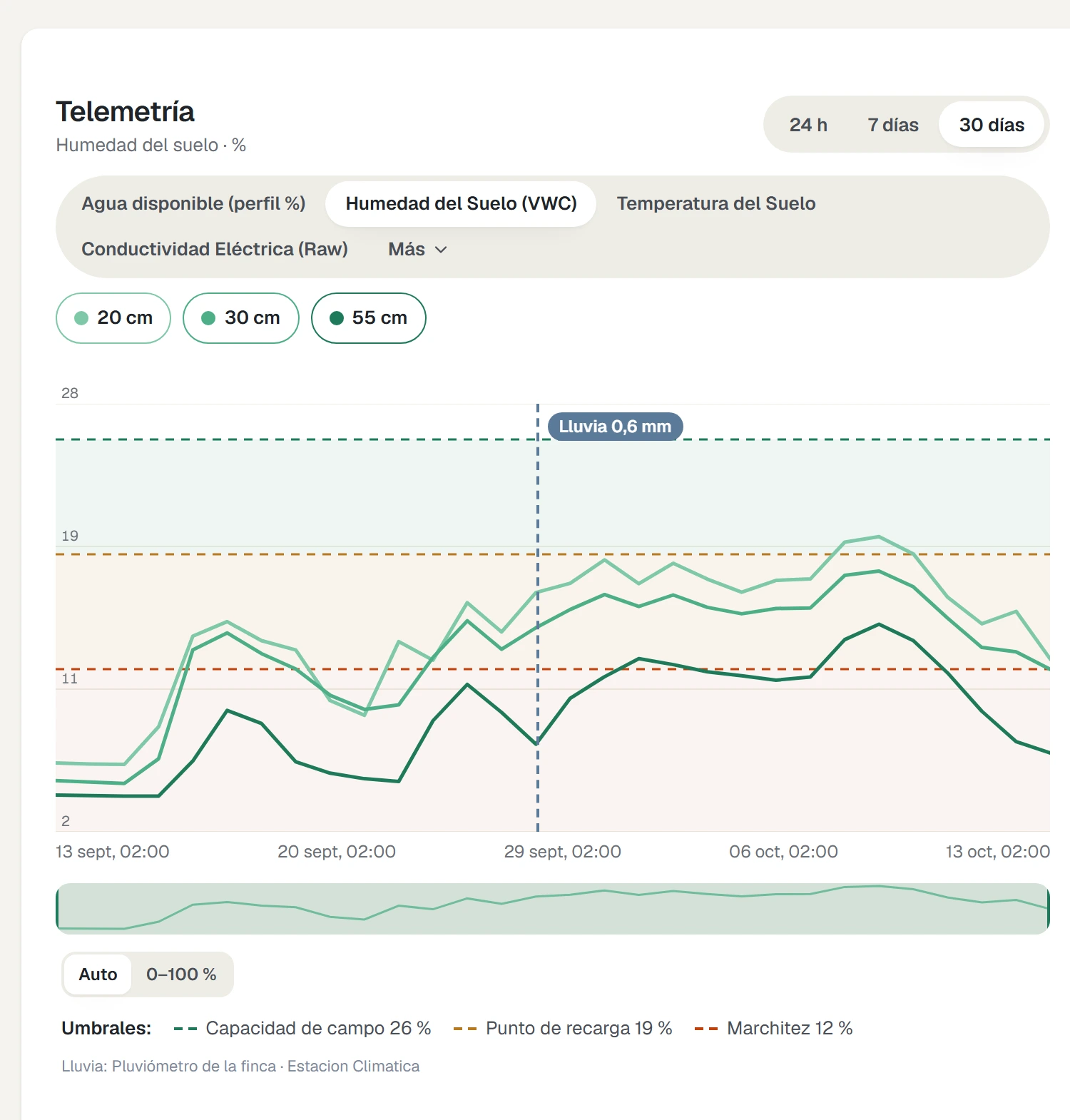
Authentic AgrolabX platform screenshot. The data do not come from a truffle orchard and do not demonstrate yield or water savings. The image illustrates how moisture trends can be compared across depths.
What to check after each irrigation event
With microsprinklers, programmed minutes alone do not tell you how water was distributed. Compare emitter condition and actual flow with the soil response.
Before irrigation
Review moisture trends by depth, soil temperature and recent weather.
During and after
Record the block, duration and applied volume when known. Check which depths respond and when.
Between events
Observe how quickly each curve falls and whether similar conditions produce similar patterns.
Before making changes
Inspect microsprinkler coverage, probe position and soil characteristics; then review the plan with your agronomist.
A high moisture reading does not necessarily mean the soil is being managed well. The trend, aeration, drainage and agronomic context also matter.
Practical example: the surface is wet, but what about below?
Imagine a holm oak truffle orchard with microsprinklers. After irrigation, the 10 cm reading rises clearly, the 20 cm reading changes only slightly and the 40 cm reading barely moves.
Without measurements, you might assume the brûlé is adequately watered because the surface looks wet. With the trends, you know that water distribution and irrigation duration deserve checking against the goal for that block.
The answer is not automatically to irrigate longer. First inspect the emitter, sensor placement, soil texture and irrigation records. In another situation, limited deep movement may be exactly the intended outcome.
This is a hypothetical example, not a customer case or a measured result from a truffle orchard.
Where to install a probe without harming the brûlé
Choose a representative point in the monitored soil and wetted area, away from direct microsprinkler impact. Convenience alone should not determine placement.
The CITA Aragón truffle cultivation guide warns that disturbing soil in the brûlé can damage the fungal association. Plan installation with a specialist familiar with the orchard, minimising disturbance to roots and mycelium.
Where soils, slopes, irrigation emitters or tree ages differ, comparing representative points may be more useful than assuming one probe describes the entire orchard.
How AgrolabX helps truffle growers
AgrolabX lets growers view soil moisture and temperature at up to three depths from a phone or computer, depending on the connected sensor configuration.
Trends and history
Compare how the monitored soil responds to irrigation, rain and hot periods rather than relying on one reading.
Configurable alerts
Receive notifications when monitored variables reach conditions you have selected for review.
Weather context
View weather data and forecasts alongside soil readings. Reference evapotranspiration can provide context, but it is not a black truffle irrigation prescription.
Information for decisions
Share trends and history with your agronomist and review the next irrigation event with better context. The platform supports decisions; it does not replace agronomic assessment.
What does monitoring a truffle orchard cost?
As a reference from the public AgrolabX catalogue, a three-depth soil sensor costs €379 as a one-time hardware purchase, and the platform costs €15 per connected sensor per month, with no base fee. Taxes apply. Installation is not included in the hardware price; configuration and connectivity are specified in the proposal.
A three-depth probe counts as one connected sensor, not three separate monthly subscriptions.
The number of measurement points, depths and communications setup depend on the orchard. See equipment and pricing before deciding.
Frequently asked questions
Does the brûlé guarantee truffle production?
No. It is associated with fungal activity, but it does not guarantee that truffles will form or be harvested.
Are 10, 20 and 40 cm always the best depths?
No. They are an example for comparing layers. Choose depths according to soil, irrigation, roots and field observations.
Can a sensor tell me exactly how much water to apply?
It measures soil response at specific points. An irrigation decision also needs the system, weather, soil and management goal; there is no universal dose.
Can AgrolabX predict how many truffles I will harvest?
No. Moisture and temperature monitoring help track soil conditions, but they do not predict production on their own.
Can I check moisture and temperature on my phone?
Yes. With a compatible connected sensor and suitable network coverage, you can view readings and history in AgrolabX.
Stop managing your truffle orchard by calendar alone
See what happens beneath the brûlé, compare up to three depths and review irrigation using real soil measurements.
Tell us which truffle species and host trees you grow, how you irrigate and where your orchard is located. We can help you assess a suitable monitoring setup and proposal.