
Quick answer
There is no universal number of minutes or pulses for strawberry irrigation frequency. In professional soil-grown production, the schedule should relate estimated demand, actual flow, distribution uniformity, water-holding capacity and the moisture response in the monitored root zone.
A soil-water balance and forecast can provide a starting point. Soil readings then help check whether each pulse reached the intended zone, whether moisture falls before the next event and whether blocks behave differently.
Before changing the controller, gather:
- block flow and irrigation duration;
- tape uniformity and emitter condition;
- soil, raised-bed and production system;
- crop stage and weather conditions;
- moisture trends between events;
- drainage and fertigation records.
Why strawberries need frequent irrigation, but not a fixed schedule
IFAPA’s irrigation guidance for strawberries in Huelva (in Spanish) explains that the crop needs an appropriate soil-moisture level and high-frequency irrigation. That does not make one duration suitable for every field.
Frequency and duration depend on soil storage, the root-zone volume, crop demand, system flow and conditions under the cover. The starting point also changes through the season: a newly established crop, a cool period and a higher-demand period cannot be reviewed in exactly the same way.
IFAPA’s 2024 Berry Irrigation Scheduling Manual (in Spanish) combines weather forecasts, FAO methodology and field data to calculate irrigation times. The recommendation is a starting point that still needs to be checked against the water delivered and the response observed.
Four checks before making a pulse longer or shorter
Water actually applied
Convert minutes into volume using the block’s measured flow. Record pressure, tape length, emitters and incidents. Two events of equal duration may not deliver the same amount.
Distribution uniformity
A reasonable average can hide areas receiving more or less water. Check the system and compare points within the block before blaming the crop.
Demand under the cover
The outdoor forecast provides context but does not fully describe conditions under a tunnel. Crop stage, temperature, radiation, ventilation and canopy development all matter.
Soil response
Follow the trend before and after irrigation at representative points. A single percentage does not tell you whether the pulse was sufficient, excessive or unevenly distributed.
IFAPA’s work on drip-tape uniformity and irrigation duration (in Spanish) makes the same distinction between a schedule and the system’s real ability to deliver water in the intended way.
Frequency and duration solve different problems
Frequency and duration are reviewed together, but they are not interchangeable. The final decision depends on the field and professional judgement.
In its strawberry irrigation-frequency trials (in Spanish), IFAPA combined weather-based scheduling, crop coefficients, water meters and soil-moisture monitoring. That combination avoids judging a programme by pulse count alone.
How to use soil-moisture sensors between irrigation events
A probe represents the point and depths where it is installed. Its value depends on whether that position represents the decision: part of a bed, one irrigation block, a soil type or a difference you want to compare.
The soil-moisture probes described by IFAPA (in Spanish) can track changes and trends at different depths. In practice, look for sequences:
- how much moisture changes after a pulse;
- which depths respond and in what order;
- how long the trend takes to return towards its previous level;
- whether the pattern repeats under comparable flow and conditions;
- whether one area behaves differently and needs inspection.
These signals do not prove stress, drainage or a fault on their own. They tell you what to check next: tape, pressure, emitters, siting, soil, roots or scheduling.
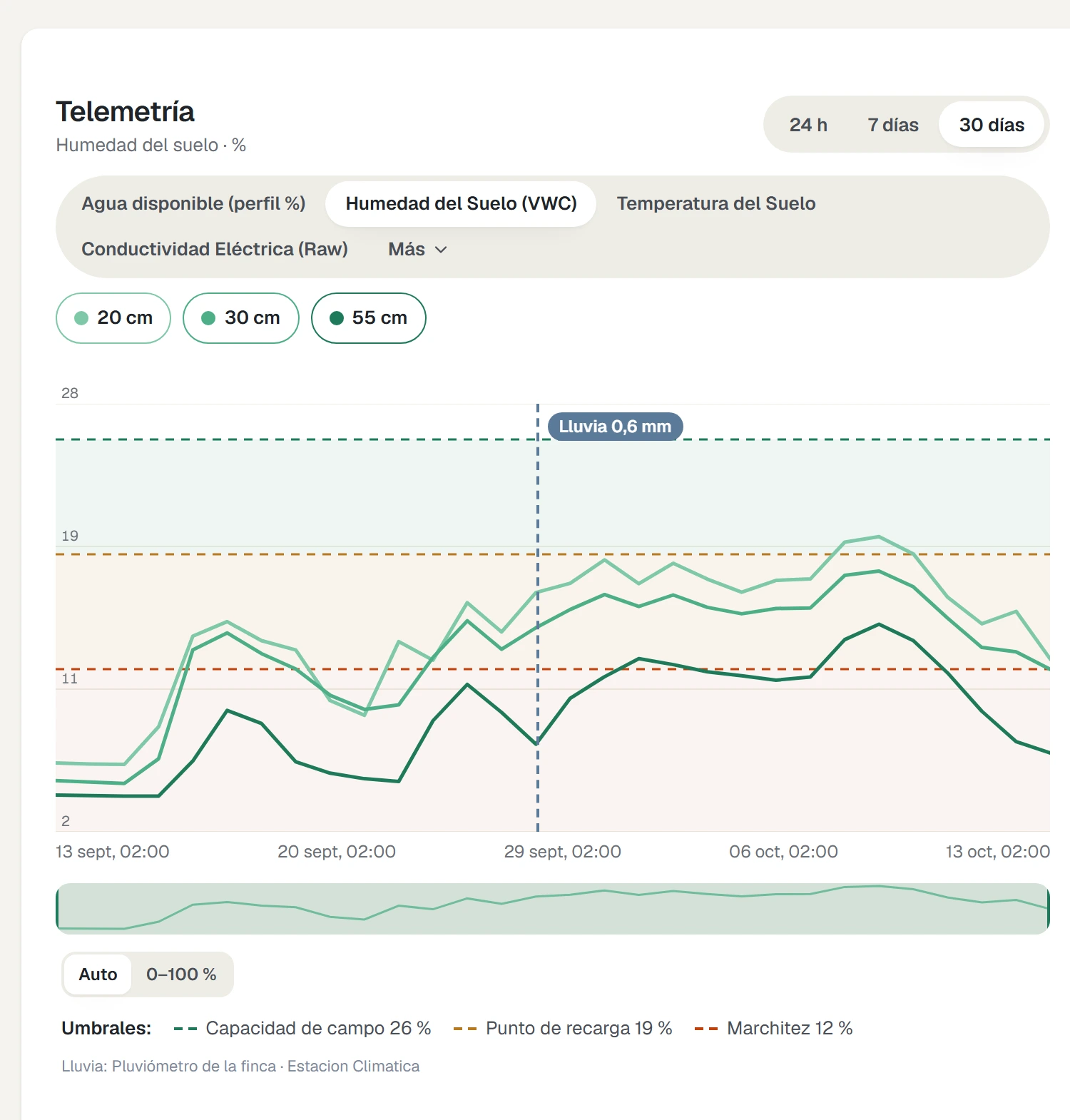
Authentic AgrolabX screenshot. The data shows the interface; it is not from a strawberry trial and does not prove an agronomic result.
A review cycle you can repeat each week
Start with a reasoned schedule
Use estimated demand, crop stage, soil and system data to set an initial programme with your agronomist.
Record what was applied
Log date, block, duration, available flow or volume, incidents and controller changes.
Observe the response
Compare curves before and after irrigation and across equivalent depths or areas.
Check the field
Inspect tape, pressure, emitters, drainage, roots and sensor position before assigning a cause.
Change one variable
Adjust frequency or duration for a documented reason, then observe the next cycle.
This process creates a useful history: what was expected, what was applied, what was observed and why the programme changed. Without that context, a precise-looking graph may still fail to answer the important question.
Example: two blocks with the same programme and a different response
Imagine a soil-grown strawberry farm under tunnels in Huelva. Two blocks receive the same irrigation duration. In one, moisture rises at the monitored levels and falls gradually before the next event. In the other, the response is smaller and appears at only one level.
The manager does not automatically add minutes to the second block. They first check pressure and flow, inspect tape and emitters, review sensor position and look at the raised bed. They then decide with their agronomist whether to correct the system, move the measuring point or adjust the programme.
This is a hypothetical example, not a customer case or a promise of water savings or yield. It shows how measurements can organise an investigation without turning a curve into a diagnosis.
What electrical conductivity adds in fertigated strawberries
When a compatible sensor provides electrical conductivity, its trend can add context about salts at the measuring point. It must be read alongside moisture, temperature, irrigation water, drainage, recorded inputs and appropriate analyses.
IFAPA’s work on optimising strawberry fertigation (in Spanish) monitored irrigation water, soil solution and the plant. That methodology is a reminder that one EC reading neither identifies individual nutrients nor prescribes a dose.
What AgrolabX adds to a strawberry irrigation review
AgrolabX brings together compatible moisture, temperature and EC readings, weather, recommendations and plot history. Configurable WhatsApp and email alerts highlight situations that need attention, while reports make it easier to review the season with an agronomist.
The platform does not open or close valves by default and does not impose a universal schedule. Its value lies in connecting the soil reading with context and preserving the reason for each review.
Explore AgrolabX for strawberries · See the irrigation solution
Frequently asked questions
How many times a day should strawberries be irrigated?
There is no universal frequency. It depends on demand, soil, stage, system, flow, uniformity and the observed response. A recommendation should be adapted to the field and reviewed with an agronomist.
Are more short pulses better than fewer long pulses?
It depends on volume, soil storage, water distribution and the goal. Compare alternatives with known flow and profile observations; do not decide from minutes alone.
Where should a soil-moisture sensor be installed in strawberries?
At a point and depths that represent the area and decision you need to review, considering the bed, plants, tape, roots, soil and blocks. The installation should be documented and checked in the field.
Does soil moisture alone tell me how much to irrigate?
No. It is a local observation that should be combined with weather, crop, applied volume, uniformity, drainage and professional judgement.
Does sensor EC replace a nutrient analysis?
No. Conductivity is a signal related to salts and also depends on moisture, temperature and method. It does not identify individual nutrients or prescribe a dose.
Does AgrolabX automate irrigation?
You should not assume so. AgrolabX provides monitoring, recommendations and alerts to support decisions. Physical control requires a specific, validated integration.
Sources and scope
Public institutional sources consulted on 20 November 2026:
- IFAPA: Berry Irrigation Scheduling Manual, 2024 (in Spanish).
- IFAPA: effect of irrigation frequency in strawberries (in Spanish).
- IFAPA: drip-tape uniformity and irrigation duration (in Spanish).
- IFAPA: FDR probes for soil-moisture measurement (in Spanish).
- IFAPA: optimising strawberry fertigation (in Spanish).
These sources support principles of scheduling, uniformity, monitoring and strawberry fertigation. They do not validate AgrolabX or turn trial results into a promise for another farm.
Review irrigation pulses with data from your own farm
Tell us your region, area, irrigation blocks, soil and what you need to check between events. In a demo, we can show you how AgrolabX relates moisture, weather, recommendations, alerts and history before preparing a configuration to review with your agronomist.