
Soil tensiometer or moisture sensor?
They do not measure the same thing. A soil tensiometer measures how strongly the soil holds water, helping you understand the effort roots need to extract it. A connected sensor integrated with AgrolabX tracks soil moisture and, depending on the device, temperature and electrical conductivity at one or more depths.
Choose around the question:
- tensiometer: “How tightly is water held?”;
- moisture sensor: “How is water content changing through the profile?”;
- connected system: “What happened after irrigation, and do I need an alert?”.
No reading should be interpreted without soil, crop, roots and irrigation context.
Soil tensiometer vs connected sensor
The FAO distinguishes two useful irrigation variables: volumetric water content describes how much water is present in the observed soil volume, while matric tension describes the effort required to extract it. They are related, but they are not interchangeable without understanding the soil.
A comparison of measuring principles and monitoring approaches, not brands. Exact capabilities depend on the device and installation.
How a soil tensiometer works
A conventional tensiometer has a water-filled tube, a porous ceramic cup at the buried end and a vacuum gauge. As the soil dries, it pulls water through the ceramic and the tension reading rises. When the soil becomes wetter, the reading falls.
The IFAPA technical report on manual and electronic tensiometers explains this principle and stresses that the measurement is indirect: the instrument observes how the soil around the cup holds water.
What it adds
- A measurement physically linked to water availability for roots.
- A consistent point for monitoring changes over time.
- Manual and electronic versions for different levels of supervision.
What it requires
- Correctly hydrating and filling the tube and ceramic cup.
- Avoiding air pockets and ensuring contact with the soil.
- Checking the vacuum, internal water and condition of the ceramic.
- Interpreting the reading for the particular soil and crop.
Do not copy a threshold from another farm. Texture, structure, depth, roots and salinity affect the relationship between tension and water content. Published ranges are starting references, not universal recipes.
Installation errors change the reading
The ceramic cup must exchange water with the surrounding soil. An air gap, disturbed soil or a point that does not represent the wetted zone can produce a plausible reading that describes the wrong place.
Define the decision
Decide whether you need to time irrigation, check how deep water moves or compare blocks.
Choose a representative area
Consider soil, emitters, roots, slope and management differences. One point does not automatically represent the whole farm.
Select the depths
Relate each measuring point to the root zone you need to observe; do not copy depths from another crop.
Install with good contact
Prepare the device according to its instructions and avoid gaps between the ceramic cup or probe and the soil.
Build your own reference
Observe several rain, irrigation and drying cycles before turning one reading into a rule.
IFAPA recommends hydrating the ceramic in advance, filling the tensiometer and checking that it responds to drying and returns towards zero when rehydrated. Maintenance is part of data quality, not an optional detail.
When a connected soil sensor adds more value
A manual tensiometer may be enough when you need to check a specific point and can visit it often enough. A connected system makes more sense when you need trends, depth comparisons or alerts without physically checking every instrument.
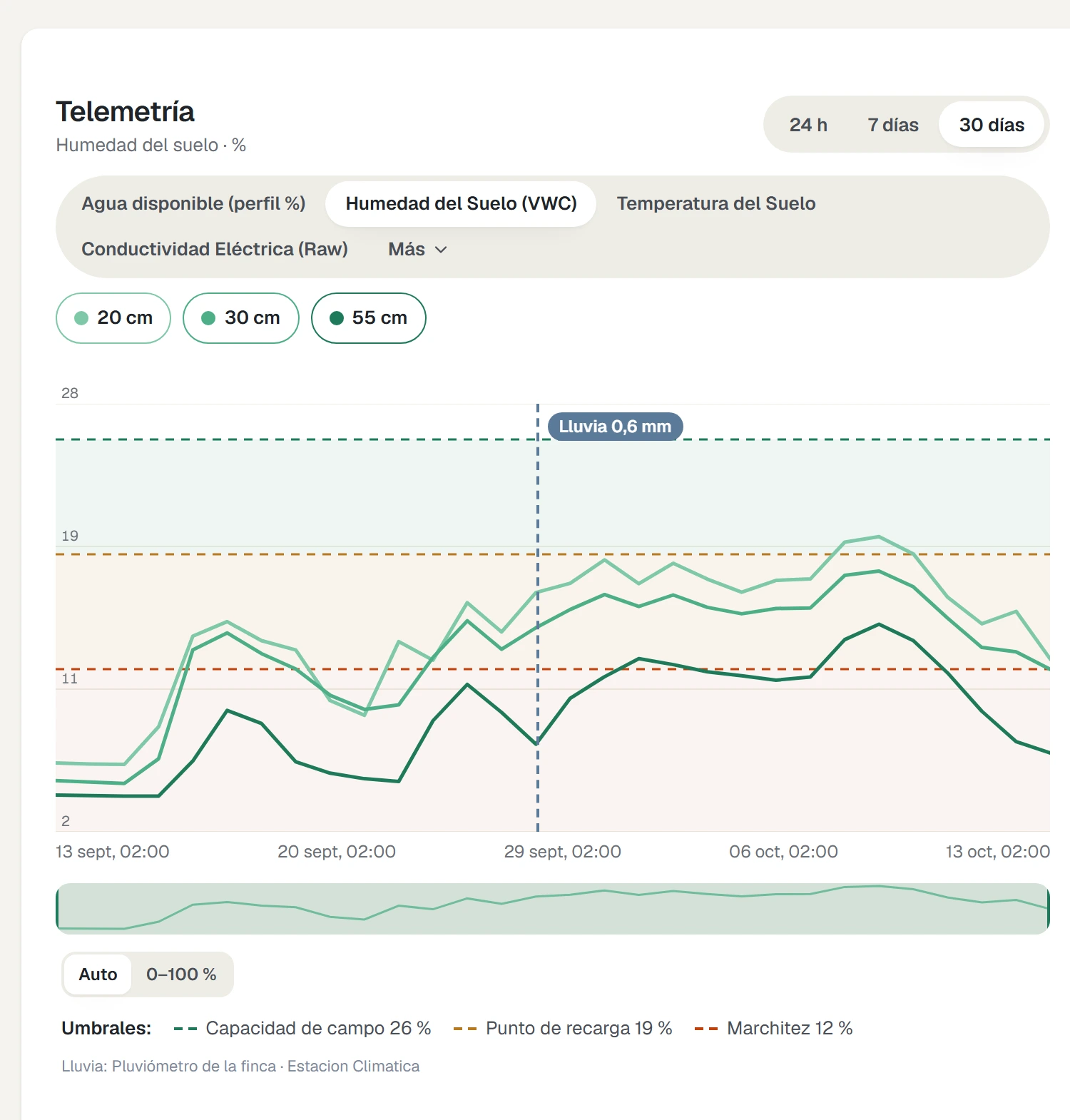
Authentic AgrolabX screenshot showing moisture by depth. It is not tensiometer data and does not prove an agronomic result; it illustrates how the soil profile can be reviewed over time.
Check the irrigation response
See which depth responds first, how long the lower layer takes to change and how each zone dries before the next event.
Put the reading in context
Relate moisture trends to rainfall, temperature, atmospheric demand, crop and the irrigation programme.
Find situations worth checking
Set alerts when data reaches farm-specific thresholds. An alert prompts a review; it does not change irrigation automatically.
Share the monitoring
Keep history and reports so the farmer and agronomist can work from the same charts and recorded decisions.
The University of Minnesota groups soil moisture sensors into devices that observe volumetric water content and devices that measure tension. It also notes that readings must be refined for the soil and checked against actual crop response.
Which option fits your farm?
Choose a tensiometer if…
- you need matric tension at a specific point;
- you can take readings and maintain it regularly;
- its operating range fits your soil;
- you have the technical basis to define and review thresholds.
Consider AgrolabX if…
- you want to check the soil remotely;
- you need to compare one, two or three depths;
- you want history, alerts and weather context;
- you oversee several areas or share data with an agronomist.
The two approaches can also be combined when each answers a different question. Before buying, define which decision the data should change and how you will check that the measurement represents the root zone.
AgrolabX connected sensor pricing
Tensiometer prices depend on construction, range, manual or electronic reading and data logging. AgrolabX does not publish tensiometer prices because its documented offer is based on connected soil sensors and its platform.
Soil hardware
- 1 depth: €199*
- 2 depths: €299*
- 3 depths: €379*
One-off purchase. The hardware is bought separately and belongs to the customer. Installation and connectivity are defined for the farm.
AgrolabX platform
Per connected sensor€15/month*
No minimum fee or base subscription. It includes platform access and the functions available for the connected data: monitoring, recommendations, weather, alerts, history and reports.
*Prices exclude taxes. Hardware and installation are separate. One soil device with several depths counts as one connected sensor.
Soil tensiometer questions
Does a tensiometer measure soil moisture percentage?
Not directly. It measures matric tension or potential: a quantity related to the effort needed to extract water from the soil. Estimating water content requires relating the reading to the soil characteristics.
Does a higher value mean more water?
No. In a conventional tensiometer, the reading rises as the soil dries and tension increases; it falls as the soil becomes wetter.
Can I use the same threshold on every field?
No. Texture, structure, crop, roots, depth and management change the interpretation. Thresholds need to be defined and checked for the farm.
Does AgrolabX sell tensiometers?
AgrolabX’s public offer focuses on connected soil sensors and its platform. Variables, depths, connectivity and the monitoring goal are reviewed before a quote.
Does the system change irrigation automatically?
Not by default. AgrolabX provides monitoring, recommendations and configurable alerts; irrigation decisions and actions remain with the farmer and agronomist.
Choose the data that supports a decision
Tell us what you need to observe in your soil, crop and irrigation system. We will propose a setup that separates hardware, installation and platform access.