
You have a rainfed olive grove. There’s no valve to open and no controller to adjust. Someone suggests installing soil moisture, temperature and electrical conductivity sensors and you think: “Why would I measure it if I can’t irrigate?”
The objection makes perfect sense. If a sensor’s only use were to switch on irrigation, it wouldn’t do much on your farm. But you also make decisions about cover crops, soil conservation and the areas that need attention. For those decisions, knowing how the ground responds can be very useful.
Measuring can add a lot when it answers a specific question. The key is turning the reading into a decision: what to check, where to intervene or which management to evaluate with your agronomist.
“Knowing how much it rained is enough for me”
The rain gauge records rainfall. Moisture sensors let you see how the water held in the soil changes, at the points and depths where they are installed.
They are two complementary pieces. After a rain event, it’s worth knowing whether the response stays near the surface, also appears further down or differs between areas. And watching what happens over the following days.
Soil that’s wet on top doesn’t describe the whole profile. Nor does a single probe tell the story of all the roots.
The curves guide the review; on their own they don’t quantify the farm’s entire water reserve or identify the cause of a difference.
To interpret water availability you need the soil type, its water-holding capacity and the roots. The same moisture percentage can mean different things in different soils.
“If I can’t irrigate, there’s nothing I can do”
Some management decisions still exist even without irrigation. One of the clearest is how to manage the cover crop.
Cover protects the soil, but while it’s alive it also uses water. Reviewing its growth together with moisture and the forecast can provide criteria for deciding on its control with your agronomist. There is no mowing date or moisture percentage that works for every olive grove.
IFAPA (Andalusia’s agricultural research institute) addresses precisely how to adapt management to local conditions in its report Soil management strategies in Andalusian rainfed olive groves (in Spanish), published on 8 September 2026. Its work on Gest-Cubierta (in Spanish) combines weather, satellite and water balance to support cover crop monitoring.
The practical application we suggest is simple: bring what you observe in your soil into that conversation about management. These studies don’t evaluate AgrolabX or prove results for our sensors.
An example: spring, living cover and days without rain
Imagine a farm where the cover keeps growing and moisture is dropping at the monitored points. This is a hypothetical example, not a customer result.
The grower reviews the trend, the state of the olive trees, the forecast and soil differences with their advisor. That information can help assess whether to bring forward cover control in one area or keep monitoring.
The sensor doesn’t decide when to mow. It adds an extra observation so the decision isn’t made purely out of habit.
You can also document how moisture evolves where you change management or keep pruning residues. To attribute an effect you need comparable areas and monitoring: two different curves don’t, on their own, prove that one practice is better.
“I already check the temperature on my phone”
The forecast shows air conditions. Soil temperature describes the environment where the roots are, at the depth measured.
Research by the University of Córdoba and IAS-CSIC found that soil temperature influences water uptake in olive and almond trees. You can read the University of Córdoba’s explanation of the study (in Spanish).
What’s it for? To add context to moisture monitoring and compare conditions between points or moments of the season. Moist, cold soil doesn’t tell the same story as moist, warmer soil.
It isn’t a thermometer that tells you, on its own, how much fertiliser the olive tree needs or when it will flower. Its usefulness comes from interpreting it together with water, soil and the state of the crop.
“EC only makes sense if I fertigate”
Electrical conductivity (EC) provides information related to salts, even without fertigation. How useful it is depends on the farm and on whether there is a salinity question to investigate.
First you need to know what the device measures. The soil’s apparent EC is not directly equivalent to that of the soil solution or of a laboratory saturation extract. Moisture and temperature affect the reading.
In very dry soil, a low apparent EC doesn’t prove there are no salts. And a rise after rain doesn’t automatically mean more fertiliser is available.
It works as a complementary signal to review changes, compare equivalent conditions and guide sampling with your agronomist. A salinity diagnosis requires the right method; fertilisation needs analyses and agronomic judgement.
The study by Brevik and colleagues on soil electrical conductivity shows the influence of moisture and temperature on the reading. It is experimental research, not a validation of AgrolabX hardware.
“I know my farm without needing a chart”
Knowing the farm helps you choose where to measure and interpret a difference. Experience and history can work together.
Perhaps you know that a slope dries out sooner, that a hollow holds moisture or that one area always responds worse. Monitoring lets you compare those observations between visits and seasons.
The useful question is: “What data am I missing to better understand something I can already see?”
Define the decision
Start with a question: response to rain, cover crop monitoring or differences between areas.
Choose meaningful points
Consider soil, slope, effective depth and roots. A convenient point next to the track may not represent what you need to observe.
Interpret a sequence
Compare before and after rain and record the management carried out. Check the installation and any anomalous readings.
Check in the field
Share the history with your agronomist and check possible causes before changing a practice.
There is no universal number of sensors per hectare or a depth that works for every olive grove. The setup should respond to the variability and to the decision you want to improve.
What AgrolabX brings to an olive grove that isn’t irrigated
The value of checking your farm from your phone lies in being able to relate what’s happening. AgrolabX brings together compatible sensors, weather, satellite data and history to make that monitoring easier.
In a rainfed grove, the conversation can start with very specific questions: what happened in the soil after the last rain? Which area deserves a visit? What has changed since we started controlling the cover?
From data to shared monitoring
You can review trends and share them with your agronomist. Configurable WhatsApp and email alerts help flag situations that need attention; reports keep the context of the season.
The forecast complements these observations. Satellite images can guide the review of differences, although they don’t explain their cause on their own.
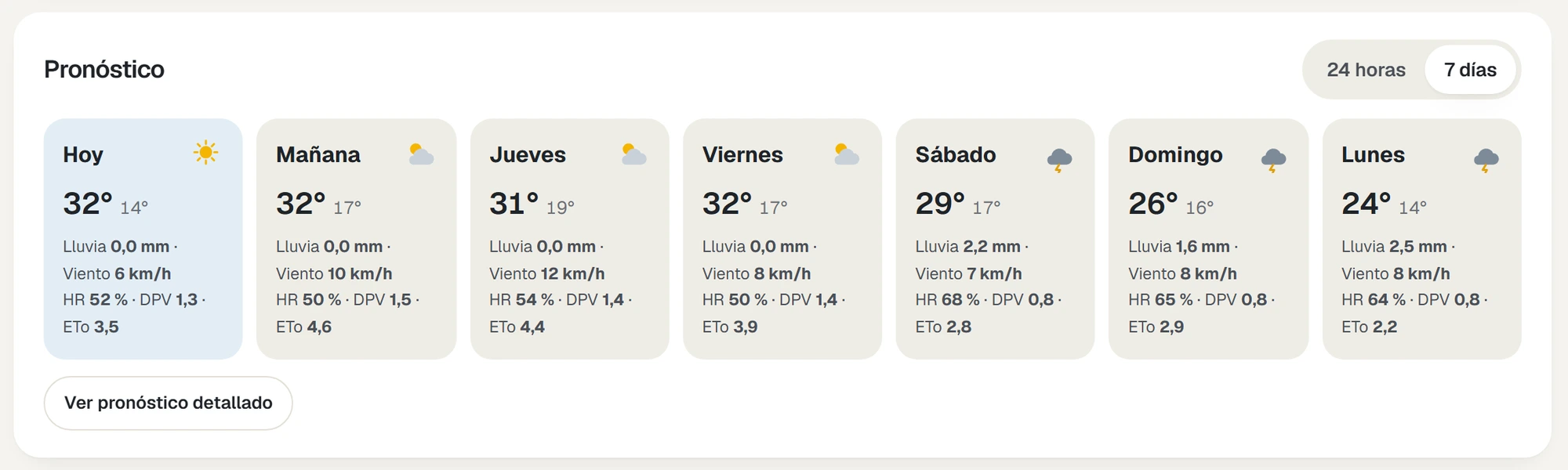
Existing AgrolabX screenshot. It illustrates the interface; it is not a current forecast for your farm or a rainfed olive case.
The platform costs €15 per connected sensor per month, with no minimum fee (taxes apply). Hardware is quoted separately. The proposal should start from the information you need and how you’re going to use it.
“What if I only look at the data and don’t change anything?”
Then it’s worth defining how you’ll use it before buying.
Measuring makes more sense if you can link it to a management decision, to monitoring with your advisor or to a question that comes up every season. If nobody is going to interpret the data, the investment loses much of its value.
You also need to prioritise: moisture, temperature and EC won’t necessarily add the same value on every farm. To start with, observing the response to rain may be more useful than chasing a complex interpretation of conductivity.
Does a sensor prevent drought damage?
It doesn’t provide water or remove climate risk. It can help you follow the situation and review the management decisions that are within your reach.
Can I know when to mow the cover just by looking at moisture?
No. You need to consider cover growth, the forecast, soil, crop and management conditions. Moisture is one piece of that decision.
Does EC tell me how much fertiliser to apply?
No. It doesn’t replace soil and leaf analyses or identify specific nutrients. Its reading also depends on moisture, temperature and the measuring method.
Will a setup designed for irrigation work for me?
Compatible devices can measure the same variables, but points, depths, thresholds and goals should be planned for your rainfed grove. Copying an irrigation setup isn’t a good idea.
Sources and scope
Consulted on 15 October 2026. The practical applications in this article are a suggested interpretation, not results measured by AgrolabX.
- IFAPA, 8 September 2026: report on soil management strategies in Andalusian rainfed olive groves, linked in the cover crop section.
- IFAPA, 21 May 2024: Gest-Cubierta report on cover crop monitoring in Andalusian tree crops.
- University of Córdoba and IAS-CSIC, 2016: outreach on the study of soil temperature and water uptake in olive and almond. Experimental thresholds are not turned into a field recipe.
- Brevik and colleagues, 2003: experimental study of the influence of moisture and temperature on soil EC. It supports the need to interpret conductivity in context, without extrapolating its figures to an olive grove.
Your olive grove is rainfed. The decisions are still yours.
You can’t schedule the next rain. You can better observe what happens when it arrives and use that information to review how you manage your farm.
Tell us where your olive grove is, how big it is and which decision you’d like to make with more information. In a demo we can show you how the data is viewed and assess which monitoring makes sense for you.