
What an agricultural weather station does
An agricultural weather station measures and records variables such as air temperature, relative humidity, rainfall, wind and solar radiation at a point on the farm. When it is correctly sited, it provides local context for reviewing irrigation, frost risk, field operations and crop conditions.
The equipment alone is not the answer. You need to choose the variables, select a representative site, maintain the sensors and connect every reading to a decision.
Before buying, define:
- which decision you want to review;
- which variables you need;
- which area the site should represent;
- how the station will transmit data;
- who should receive alerts;
- how maintenance will be recorded.
Home and agricultural weather stations serve different jobs
A home station can describe conditions around a house. Agricultural use also requires a representative measuring point, reliable field operation and a way to relate weather to plots, soil and management decisions.
This compares uses, not brands. Capabilities depend on the equipment, its installation and the connected platform.
The key difference is not the word “professional”. It is whether the measurements answer an agricultural question and can be used with the rest of the farm’s information.
Which sensors a farm weather station needs
Spain’s public SiAR agrometeorological network (in Spanish) measures air temperature and humidity, wind speed and direction, radiation and rainfall to calculate reference evapotranspiration. These are useful core variables, but an individual farm does not have to copy a national reference station.
Air temperature and humidity
They provide minimum, maximum and trend data, including conditions that may need attention such as possible frost. They do not diagnose crop damage or disease on their own.
Rainfall
A rain gauge records precipitation at the installation point. It helps you compare actual rain with the forecast and review the next irrigation; it does not automatically describe every part of the farm.
Wind
Wind speed and direction add context for field operations and atmospheric demand. Nearby obstacles can strongly distort the reading.
Solar radiation
Radiation is one of the variables used to calculate reference evapotranspiration. It also helps compare days and periods, within the limits of the model and crop context.
The Andalusian Agroclimatic Information Network (in Spanish) uses these variables to support irrigation-needs estimates. An on-farm station complements a public network when you need conditions from the point where you manage the crop.
Where to install a weather station on a farm
Siting can matter as much as the hardware. The Andalusian regional government (in Spanish) highlights location, instruments, protection, orientation and height. The World Meteorological Organization’s observation guide provides specific methods for temperature, humidity, wind, rainfall and radiation.
Define the area it should represent
Decide whether the station should describe one plot, elevation, exposed area or a point with a specific risk. One station does not automatically represent an entire farm.
Avoid obvious interference
Check shade, buildings, trees, machinery, heat-storing surfaces and irrigation spray that could distort measurements.
Install each sensor correctly
Height, orientation, levelling and separation depend on the variable and equipment. Follow the validated setup and document any limitations.
Check coverage and power
Confirm how data will be transmitted and whether the power supply, panel and battery can be maintained at that location.
Plan maintenance
Clean the rain gauge, inspect fixings and power, investigate anomalous readings and record every intervention.
Public network or your own station?
Public agrometeorological networks provide open, quality-controlled data from stations spread across a territory. They are valuable for regional context and long series. The nearest station, however, may sit at a different elevation or exposure, or record a different storm from the one that reached your field.
An on-farm station becomes useful when you need to:
- confirm rainfall in the monitored area;
- follow minimum and maximum temperatures where you act;
- receive alerts linked to local measurements;
- compare weather, soil and recommendations in one place;
- keep a history associated with your plots.
The two sources complement each other. A public network provides territorial context; an on-farm station provides proximity. Both still require attention to data quality, siting and continuity.
Example: a minimum temperature that prompts a review
Imagine a farm with a low-lying area where cold air collects and another block on higher ground. The general forecast points to a cold night, but the manager needs to know what happens at the more sensitive point.
A correctly sited station records the local temperature trend. If the configured threshold is reached, AgrolabX can send an alert so the manager reviews the situation and follows the protocol agreed with their agronomist. The alert does not confirm damage or activate physical equipment by default.
This is a hypothetical example, not a customer case or a guarantee of frost prevention. It shows why local data matters when it leads to a planned action.
What AgrolabX adds to the station
The station captures measurements. The platform’s job is to turn those readings into information that can be reviewed with the rest of the farm.
Weather, plots and decisions in one place
- Data and history from the connected station.
- Weather forecast linked to the plot.
- Configurable WhatsApp and email alerts.
- Irrigation recommendations using the available context.
- Comparison with compatible soil sensors.
- Reports and access for authorised users.
AgrolabX helps you relate weather, soil and history before deciding. It does not guarantee that one station represents every plot or replace the judgement of the grower and their agronomist.
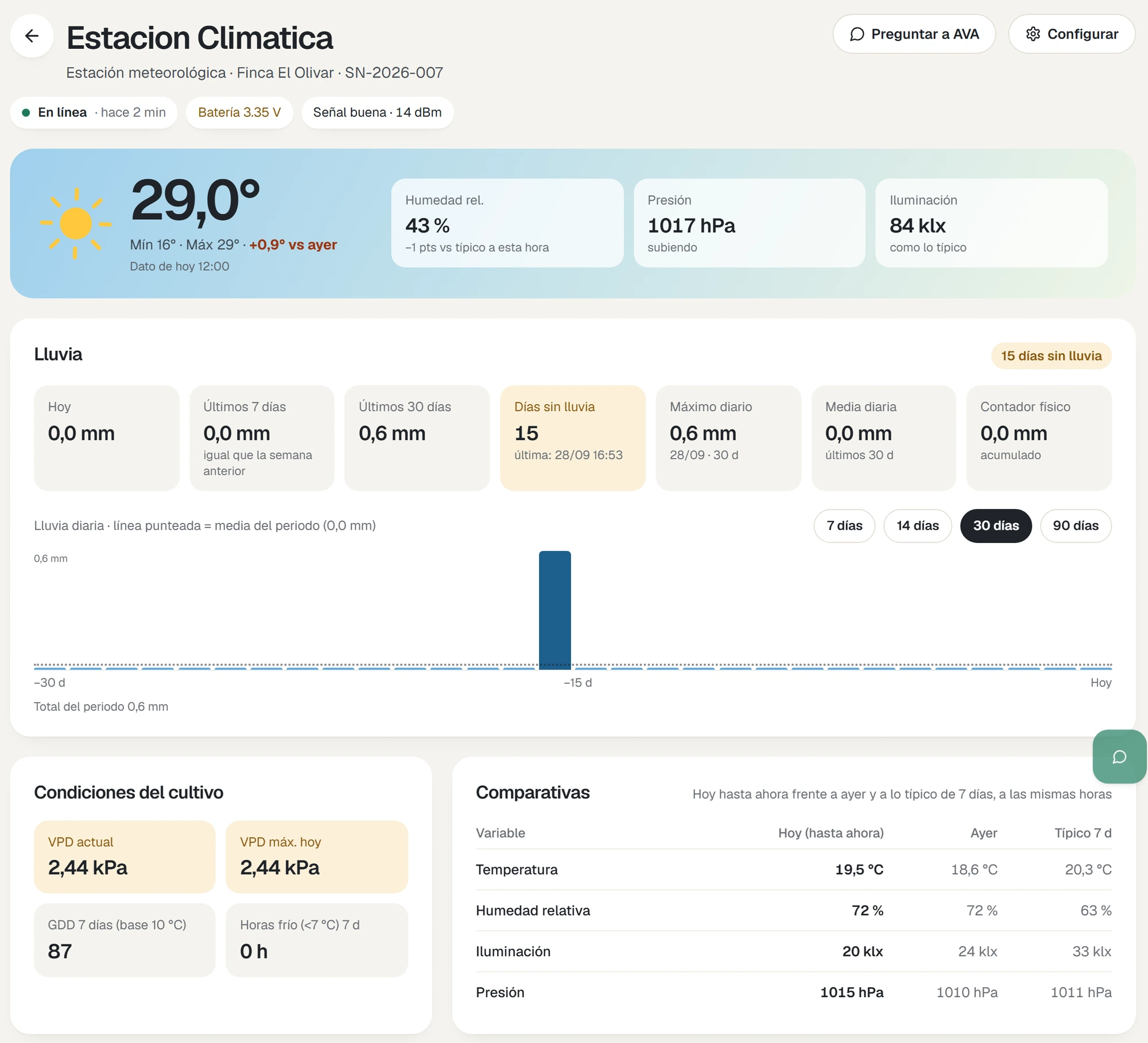
Authentic AgrolabX screenshot. The figures show the interface and are not evidence of a universal agronomic result.
Agricultural weather station cost with AgrolabX
The proposal separates one-off hardware from the monthly platform fee. Under the current public prices:
Weather and rain gauge
€499* for the hardware: a station measuring temperature, humidity and rainfall, including the structure and power equipment specified in the proposal.
The platform costs €15/month* because the complete station counts as one connected sensor.
Weather, rain gauge and wind
€599* for the complete hardware configuration with wind measurement.
The platform remains €15/month* for the connected station. Solar radiation, where needed, is an additional €329*.
*Taxes apply. Hardware is bought separately and becomes the customer’s property. Installation, connectivity and final configuration depend on the farm. See the current pricing.
The platform fee covers more than storage: it provides access to connected information, recommendations, alerts, history, reports and tools available for the agreed configuration.
How to choose without paying for data you will not use
Start with the decision
Define whether you need to review irrigation, rain, frost, wind, radiation or another specific situation.
Choose the variables
Buy only the sensors that answer those questions and confirm what each configuration includes.
Validate the site
Check representativeness, obstacles, coverage, power, security and access for maintenance.
Ask to see the workflow
In a demo, review how history, forecast, alerts, plots and soil sensors work together.
Separate every cost
Distinguish hardware, extras, installation, connectivity and the platform fee before comparing proposals.
Frequently asked questions
Is a nearby public weather station enough?
It can provide valuable regional context. An on-farm station makes sense when you need rain, temperature or other variables at the point where decisions are made. Distance, elevation and exposure affect the comparison.
How many weather stations does a farm need?
There is no universal number. It depends on area, terrain, distance between plots, weather variability and the decisions you need to represent.
Can the station send frost alerts?
AgrolabX can generate configurable alerts from the available data. An alert prompts a review; it does not confirm damage or guarantee prevention.
Is solar radiation essential?
Not for every goal. It is relevant when you need that variable for monitoring or calculations such as reference evapotranspiration. The configuration should match the intended use.
How much does it cost to connect the station to AgrolabX?
€15 per month for the connected station, with no base fee. Taxes apply and hardware is bought separately. The station counts as one sensor even when it includes several modules.
Does the station automatically control irrigation?
You should not assume so. AgrolabX provides monitoring, recommendations and alerts; physical control requires a specific, validated integration.
Sources and scope
Public and institutional sources consulted on 17 November 2026:
- Spanish Ministry of Agriculture: SiAR agrometeorological stations (in Spanish).
- IFAPA: Andalusian Agroclimatic Information Network (in Spanish).
- Andalusian government: siting and instruments for an agrometeorological station (in Spanish).
- AEMET: installing meteorological instruments (in Spanish).
- WMO: Guide to Instruments and Methods of Observation, 2024 edition.
These sources describe variables, siting criteria and observation networks. They do not validate AgrolabX or guarantee that one configuration will suit every farm.
Design the station around your farm’s decisions
Tell us what you grow, where your plots are and what you need to observe. In a demo, we can show you how AgrolabX relates the station, forecast, soil, alerts and history before preparing a proposal.